Buffett’s Silent Pivot: Decoding Berkshire’s Strategic Portfolio Shifts

The Oracle of Omaha makes stealth moves as markets churn—what's he unloading now?
Berkshire's Q3 filings reveal surprising sector rotations while cash reserves balloon to record levels. No press releases, no tweets—just classic Buffett discretion.
Financial analysts note unusual activity in energy holdings as tech positions get trimmed. That 'boring is beautiful' mantra? Suddenly looking tactical.
Meanwhile, Wall Street pundits scramble to justify their 12-month price targets after missing the quiet repositioning. 'But he hates crypto!' they cry—as Bitcoin quietly notches another 52-week high.
Retreat From Oversized Tech and Financial Stakes
One of the most noticeable adjustments is the pullback from several of Berkshire’s most crowded positions. The Apple stake – still the firm’s largest by a wide margin – was cut meaningfully, though it remains a core pillar of the portfolio. Bank of America, another heavyweight holding, was reduced as well. Verisign saw the steepest drop, with almost a third of the shares offloaded.
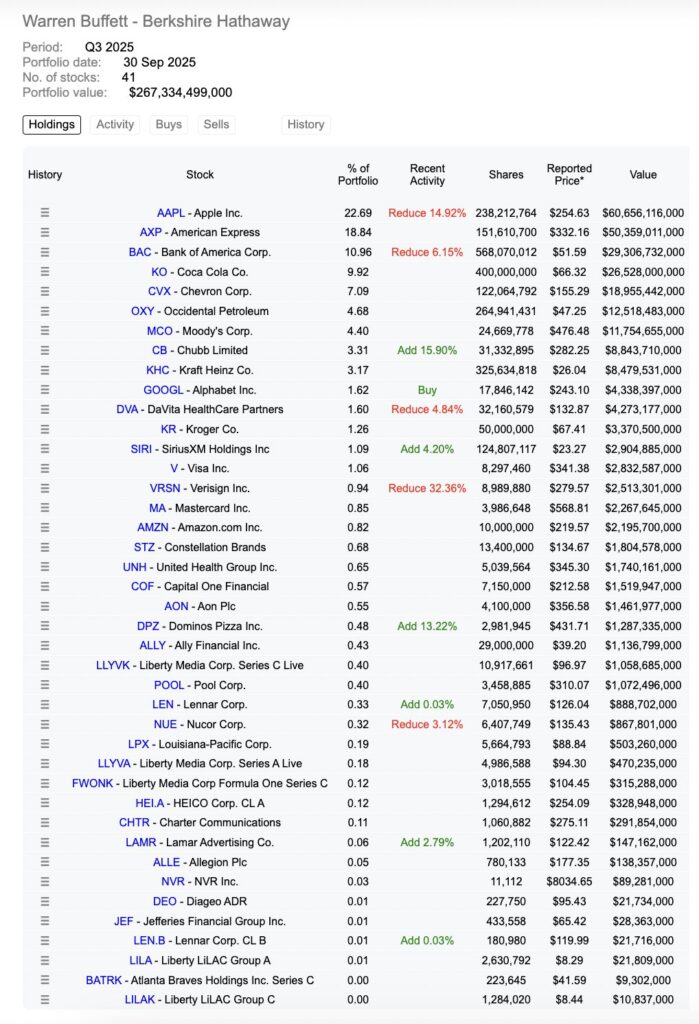
Taken together, the cuts suggest less enthusiasm for pricey tech and banking names that have dominated Berkshire’s balance sheet for years.
Reinforcing the Classics: Insurance and Consumer Strength
Where the firm stepped back in some areas, it leaned forward in others. Insurance names received fresh capital, with Chubb seeing a substantial boost. That MOVE fits perfectly with Buffett’s long-running belief that the insurance business provides the financial foundation for Berkshire’s broader operations.
Consumer-facing holdings also received attention. Domino’s Pizza was one of the quarter’s more notable additions, and smaller increases appeared in SiriusXM and even Alphabet, hinting at selective confidence in media and tech infrastructure rather than high-growth tech momentum plays.
READ MORE:
Long-Term Favorites Kept Intact
Many of Berkshire’s defining positions hardly budged. American Express continues to occupy an enormous share of the portfolio, while Coca-Cola and Chevron remain steady anchors. Modest tweaks in sectors like advertising (Lamar) and housing (Lennar) show a slow, almost surgical expansion into economically sensitive segments without signaling a major strategic shift.
A Portfolio Built for Uneven Conditions
With economic data sending mixed messages and the Federal Reserve once again shaping expectations, the latest trades look like moves designed to preserve value rather than chase opportunity. Berkshire still owns 41 publicly traded companies, but how those investments are weighted reflects a defensive posture: less dependence on stretched valuations, more emphasis on predictable earnings and cash flow.
What It All Means
Buffett hasn’t reinvented his approach – he doesn’t need to. Instead, the third quarter shows a fine-tuning of long-held convictions: step back where Optimism has run ahead of fundamentals and double down where time, not market mood, controls the outcome.
In short, tech gets trimmed, insurance gets love, and the portfolio leans a little more toward the businesses Buffett trusts to survive any weather.