Maple’s Fundamentals Are Driving Outperformance - Here’s Why It’s Outpacing the Market

Forget the noise—Maple's engine just kicked into overdrive.
While other protocols chase hype, Maple's fundamentals are quietly printing gains. The numbers don't lie: outperformance isn't an accident. It's built on a foundation that institutional players are finally starting to notice.
The Secret Sauce: Real Yield, Real Demand
Maple bypasses the speculative circus. Its model connects accredited borrowers with institutional-grade lenders, cutting out the traditional banking middlemen. This creates a flywheel of sustainable yield—the kind that makes hedge fund managers check their Bloomberg terminals twice.
A Structure Built for Storms
When market volatility hits, flimsy protocols crumble. Maple's architecture is engineered for resilience. Its pooled credit system and rigorous borrower assessment act as a shock absorber, proving that in crypto, the boring stuff often makes the most money.
Institutional Money Is Waking Up
The smart capital is moving. Tired of meme coin mania and empty governance tokens, serious investors are flocking to platforms with clear revenue models and auditable cash flows. Maple's transparency is becoming a magnet for capital seeking refuge from the sector's carnival barkers.
The Bottom Line
Maple's run isn't a fluke. It's a direct result of a product that solves a real problem in a market saturated with solutions searching for one. In a world where 'fundamentals' often means a charismatic founder and a Discord server, Maple delivers the one thing finance actually respects: consistent, verifiable returns. Even the most cynical Wall Street veteran would have to admit—that's a trend worth watching.
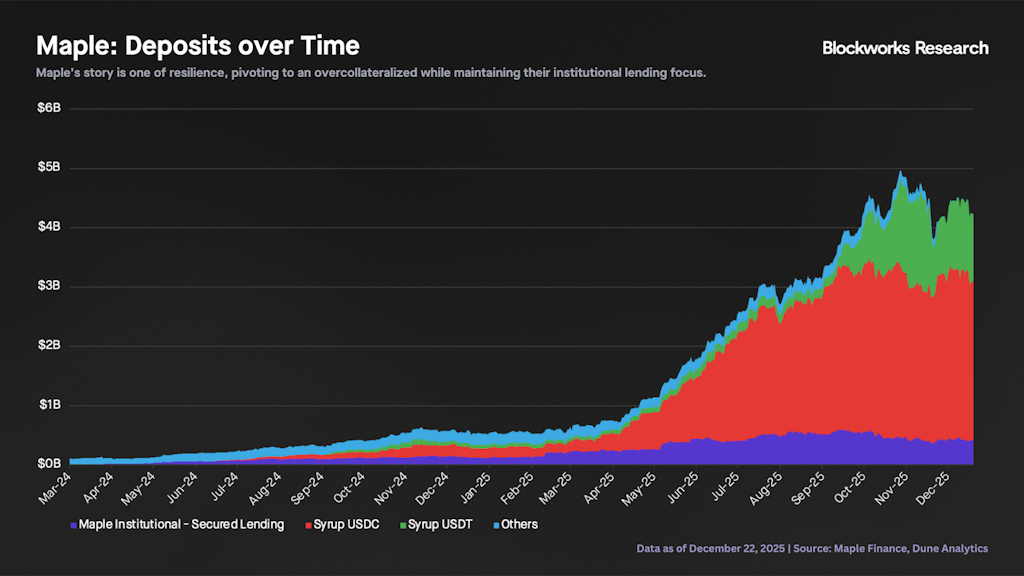
Maple, as one of DeFi’s longest-standing lending protocols, was able to come back from the 2022 credit crisis by pivoting away from undercollateralized lending toward a fully secured, overcollateralized model, with an institutional approach: Permissionless Syrup pools accept USDC or USDT deposits (syrupUSDC, syrupUSDT), while permissioned pools accept only USDC. Capital from these pools is then deployed OTC to institutional borrowers, collateralized by BTC or other highly liquid cryptoassets.
As seen below, Maple has surpassed $4 billion in deposits, with about 63% of deposits coming from the syrupUSDC pool, 27% from the syrupUSDT pool, and 10% from Maple Institutional (its permissioned secured lending pool).
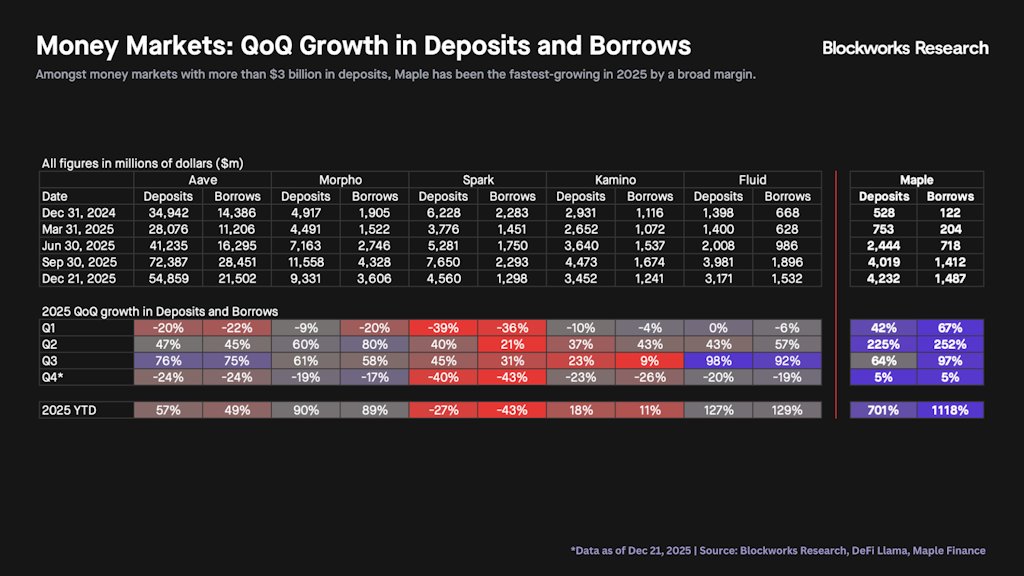
How does Maple stack up against other money markets? Among protocols with more than $3 billion in deposits, Maple has been the fastest-growing in every quarter this year except Q3, when it ranked second behind Fluid. Q2 marked Maple’s strongest quarter, with deposits up 225% and borrows rising more than 250%. Year-to-date, deposits have grown an exceptional 701%, while outstanding loans are up 1,118%. Notably, loan origination has outpaced growth in deposits, underscoring increasingly high utilization.
Maple’s growth has largely been driven by syrupUSDC, which as we mentioned accounts for 63% of Maple’s deposits ($2.66 billion) as of Dec. 21. One of the attractive selling points of syrupUSDC is the sustained high yield, linked to stable demand from Maple’s institutional client base. syrupUSDC has outperformed all other benchmark yields in the cohort year-to-date, with an average APY of ~8%. However, it’s worth noting that in recent months the yield has been declining, with Morpho’s USDC yield remaining competitive since August and outperforming sharply during November.
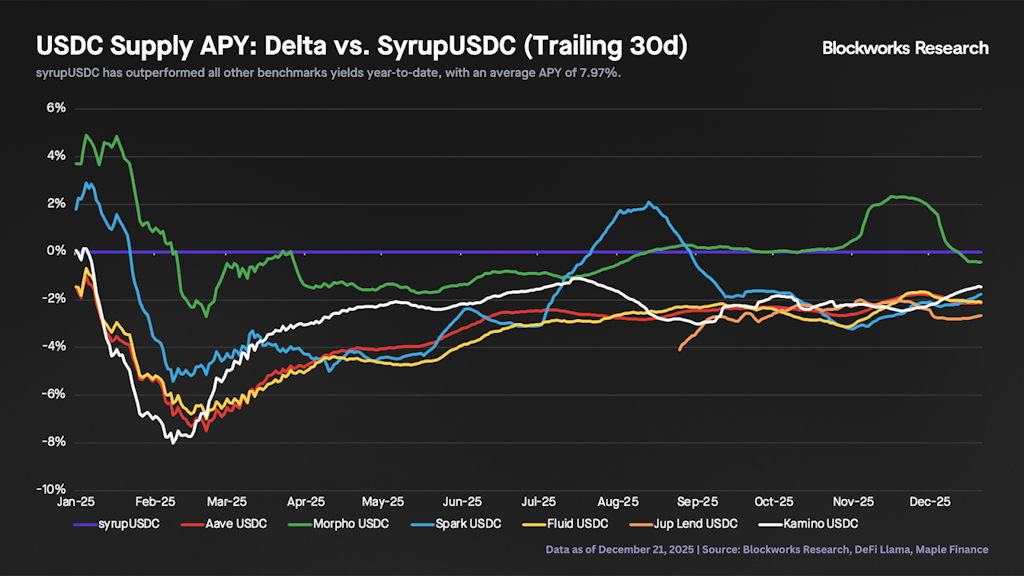
Regarding the methodology, we use market-weighted USDC supply rates across competing protocols, based on base interest paid by borrowers (excluding any incentives). We then compute trailing 30-day annualized rates and compare them to the benchmark yield, syrupUSDC.
Another growth catalyst for syrupUSDC and syrupUSDT has been DEEP DeFi integrations. Maple’s yield-bearing stablecoins have been integrated into Pendle’s PT markets and onboarded as collateral across several money markets (Aave, Fluid, Jup Lend, Spark, and Kamino), enabling looping strategies against non-yield-bearing stables. This kind of distribution can further accelerate Maple’s growth, particularly during periods when syrupUSDC outperforms benchmark yields, including Ethena’s sUSDe.
Putting it all together, Maple has outpaced competing money markets year-to-date in both deposit and borrow growth, as well as USDC supply yields. How has that performance translated into revenue? The table below compares Maple against its peers on quarterly revenue and price-to-sales multiples.
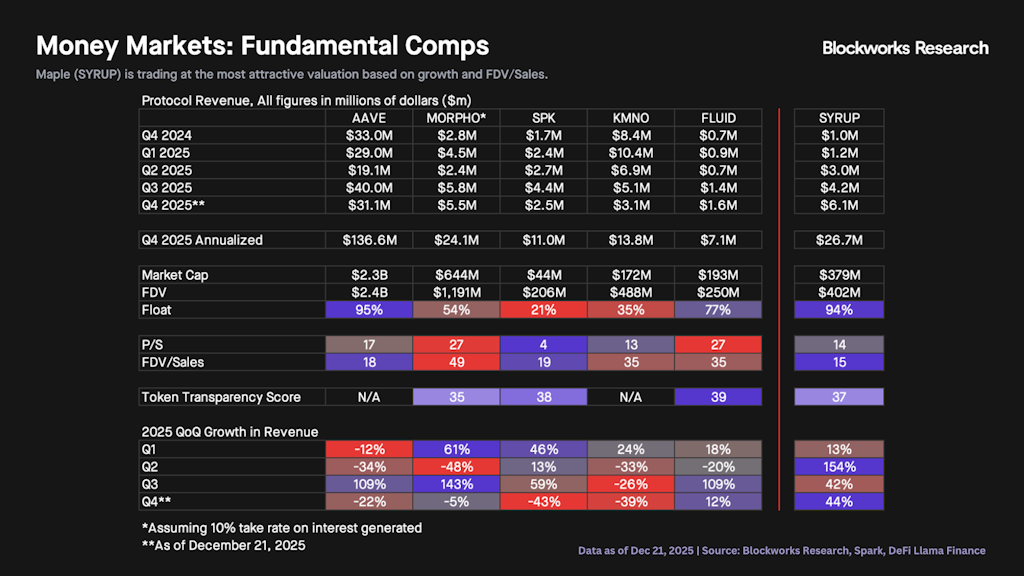
Based on Q4 2025 revenue figures, Maple (SYRUP) is trading at the most attractive valuation of the cohort on a growth and FDV/Sales basis. Maple’s annualized revenue run rate has increased 533% YoY, from $1.0 million in Q4 2024 to a forecasted $6.6 million in Q4 2025.
Regarding token distribution, all initial team, advisor, seed investor, and public sale allocations were fully vested as of 2023, eliminating supply overhang concerns. Of note, SYRUP scored 37 on the Token Transparency Framework, indicating that the project has fully disclosed its revenue streams, equity to token holder rights, advisory service providers, and executive team personnel.
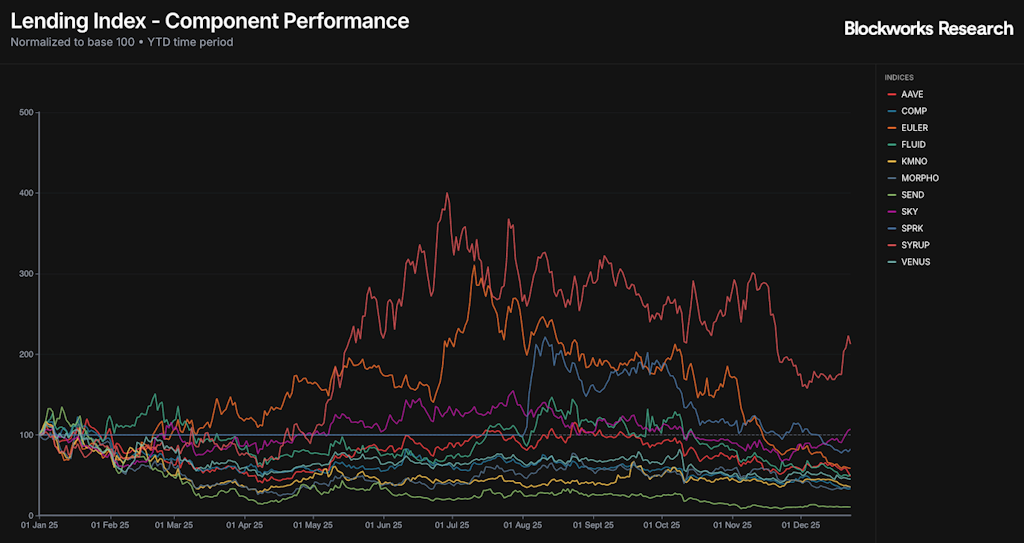
Given Maple’s fundamentals, alongside a favorable token structure (limited supply overhang and clear disclosures around value accrual), it’s unsurprising that SYRUP is the best-performing lending token year-to-date and has continued to show notable relative strength in recent days.
- The Breakdown: Decoding crypto and the markets. Daily.
- 0xResearch: Alpha in your inbox. Think like an analyst.
