Why Do Tokenized US Stocks Lose Their Peg?
 techflowAuthor: blocmates.
Author: Kristrey, blocmates
Compiled by: Shenchao TechFlow
Shenchao Introduction: In August this year, a group of traders used on-chain tokenized stocks paired with meme coins to artificially squeeze HIMS stock price up 4.5 times during a low-liquidity weekend. This incident exposed the fatal flaw of current tokenized RWAs relying on traditional AMMs for pricing, causing their prices to often be completely disconnected from the real world.
Decentralized exchange Metric proposed an "Active Liquidity Pool" mechanism, completely decoupling asset pricing from the pool's capital inventory. By introducing an independent quoting contract and adaptive liquidity ranges, on-chain RWAs can track real-world prices in real time without waiting for arbitrageurs, filling a critical infrastructure gap for on-chain stocks and block trading.

In late August, a group of traders attempted to launch a "short squeeze" on the tokenized stock of US low-priced stock HIMS.
Their approach was very simple: pair a meme coin with the tokenized stock to create a liquidity pool, then frantically buy as many tokens as possible to "control" the supply, thereby pushing HIMS's on-chain price higher and higher.
Because this action occurred over the weekend, the HIMS price in the pool soared to $132.64 at one point, while its actual market price at the close of the previous Friday was only $28.84.
But this group overlooked the most critical fatal fact: the on-chain token supply of HIMS stock represents only a tiny fraction of the total outstanding shares in the real world.
When the US stock market opened on Monday morning, the issuer of the tokenized stock quickly minted new tokens and ruthlessly arbitraged between the real stock price and the on-chain price, instantly crashing HIMS's price back to parity with the real world.
The core lesson of this story is not about the farce of trying to short squeeze a Nasdaq-listed stock.
What it truly exposes is that the vast majority of tokenized stocks today still trade on-chain using the traditional automated market maker (AMM) architecture that DeFi has used for years, where an asset's price is entirely determined by the inventory ratio of the two tokens in the liquidity pool.
This mechanism effectively severs the price connection between real-world assets (RWAs) and their on-chain mapped versions, making tokenized assets seem to exist in a parallel isolated universe.
However, if this HIMS stock had been placed in Metric's Active Pool, such an absurd price spike and depegging farce would have been impossible from the start.
What is Metric?
Metric (@metricxyz) is an innovative decentralized exchange that introduces the core design concept of "Active Pools," under which the asset pricing mechanism and liquidity provision are completely decoupled into two independent components.
This active pool design precisely solves the price disconnect between real-world asset prices and tokenized assets in DeFi pools; the latter have traditionally been highly susceptible to malicious distortion by localized individual trades.
But some may ask: since oracle networks already exist, why does this depegging still occur? Aren't oracles supposed to be the bridge connecting DeFi to the external real world? The answer is: that only holds in theory.
In Uniswap v2-type pools, quotes come entirely from the pool's own inventory asset ratio, whereas in v3 and v4 concentrated liquidity pools, quotes come from the currently recorded tick and the available liquidity depth within that price range.
Regardless of the traditional form, the crux is: unless a trader or arbitrageur actively initiates a trade to capture the spread, the pool's quote will not move on its own.
In contrast, Metric's active pools can precisely price tokenized US stocks, forex, gold, and even major cryptocurrencies by directly connecting to oracle data sources or custom pricing logic, keeping the pool's quote synchronized with the real world at all times, regardless of whether external arbitrageurs intervene.
How Active Liquidity Pools Work
Unlike conventional AMMs, active pools completely separate asset prices from the pool's actual capital inventory. Since precise pricing is the key to unlocking a new paradigm, let's first look at how pricing is achieved.
Price Provider
Within Metric pools, asset prices are calculated by an on-chain smart contract called the "Price Provider," which directly returns a complete quote including the bid price, the ask price, and the benchmark reference price.
The Price Provider contract can obtain prices from multiple sources, the most straightforward being direct connection to decentralized oracle networks such as Chainlink or Pyth, to closely track the real-time market prices of off-chain real assets.
Additionally, the contract can execute more advanced complex logic, such as reading mid-prices or time-weighted average prices (TWAP) from other DEXs, real-time exchange rates of staked assets or vaults, customized mathematical models for options, prediction markets, or synthetic assets, as well as professional trading strategies like grid trading, limit orders, Deep OTC, or volatility-adaptive orders.
Regardless of the underlying computation logic, the pool itself never forms its own price opinion; instead, this heavy and critical pricing responsibility is entirely delegated to the Price Provider smart contract.
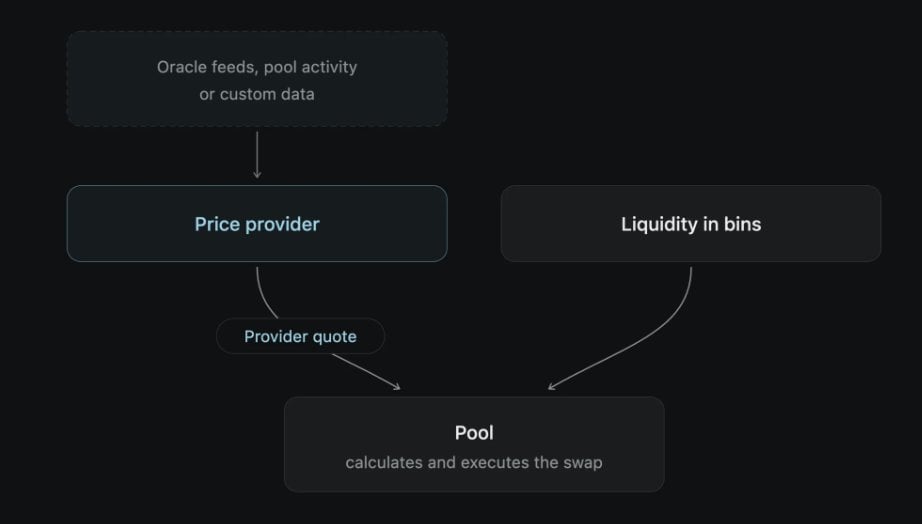
However, even with absolutely precise prices, if no liquidity providers (LPs) are willing to deposit funds into the pool, it is meaningless to traders. This is where "Liquidity Bins" come into play.
Liquidity Bins
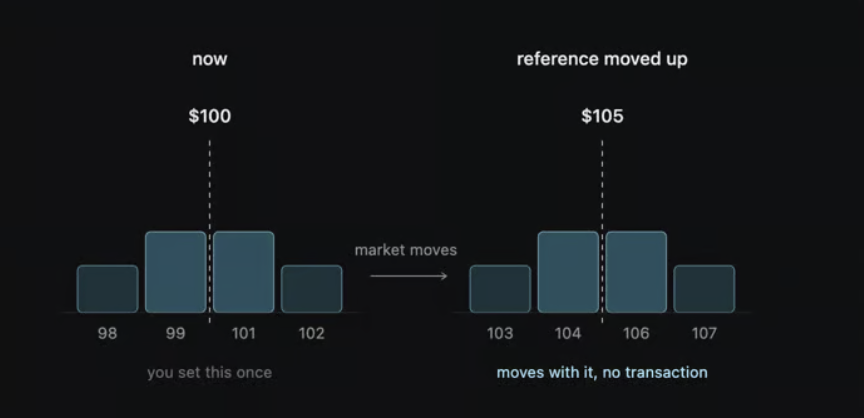
On Metric, liquidity automatically tracks the reference price provided by the Price Provider contract and is distributed across various liquidity bins centered on these reference prices. Each bin represents a certain price deviation range relative to the pool's reference price, typically expressed as a percentage.
Suppose ETH is currently trading at $2,000, and as an LP you are willing to sell at 2% above the real price and buy at 2% below the real price. This effectively means you set your ask at $2,040 and your bid at $1,960.
If an extreme one-sided move occurs overnight and ETH surges to $3,000, in a traditional Uniswap v3 concentrated liquidity pool, your position would be completely swept through instantly, leaving you with a pile of passively depreciating one-sided assets and no recourse.
But in Metric's active pool architecture, your liquidity bins dynamically shift with the reference price, and the preset rules remain strictly in effect: still a symmetric 2% range on each side of the price, meaning your ask is now automatically adjusted to $3,060 and your bid to $2,940.
In short, as long as the real market price moves, these liquidity bins automatically drift with it, so even if no actual trades occur in the token pool, liquidity never falls out of effective range.
Final Outcome: Reshaping the Experience for All Parties
Since we used the HIMS stock case at the beginning of the article, let's return to it at the end for a thought experiment.
Imagine: a reader browsing the latest health column happens to see content sponsored by men's health company HIMS, mentioning the excellent efficacy of finasteride and minoxidil in treating hair loss.
After browsing the company's official website and completing an online questionnaire, the reader is deeply impressed by its business model and very bullish on the company's prospects, deciding to buy its stock on a dip.
For some profound reason related to hair loss, this gentleman happens to be quite knowledgeable about cryptocurrencies and tokenized stocks, so he decides to open the Robinhood wallet on his phone to buy this on-chain stock.
He selects the HIMS token in the interface, enters the purchase amount, and clicks swap; however, the final execution quote that pops up on the screen is not the price he saw on the market dashboard 5 minutes ago. The price is slightly worse, not outrageously unacceptable, but enough to make him hesitate.
For ordinary retail investors with small capital, this subtle price difference may not raise much alarm; but it is precisely this ubiquitous spread that plunges LPs in traditional DeFi pools into endless pain: because prices cannot update automatically, arbitrageurs are constantly waiting to arbitrage away profits, forcing LPs into a vicious cycle of frequent rebalancing and bearing impermanent loss.
But if the HIMS token were placed in Metric's active liquidity pool, with the Price Feed set to faithfully track the real-world stock price, all participants in the ecosystem would have a completely different and more satisfying experience:
For LPs, the biggest advantage of providing liquidity to an active pool is that your position can always remain within the profitable price range, and the trading fee income earned is directly retained in the bins and automatically compounded into your initial position.
Because there is no need to manually withdraw earnings or re-establish positions, LPs also save on the high gas transaction costs associated with repeated operations. Of course, this mechanism cannot protect LPs from the systemic risk of a sharp decline in the underlying asset itself, the potential exposure to high-frequency arbitrage attacks when the pool's reference price is not refreshed in time, or other related risks and circumstances set out in the security mechanisms.
For traders, they can enjoy fair asset prices close to real market prices, without paying any hidden front-end service fees or additional slippage, only bearing the reasonable bid-ask spread between the reference price and the buy/sell prices, while Metric only charges a very small protocol fee.
Although Metric has not completely eliminated all inherent risks of financial markets, it has built a crucial piece of infrastructure for the future we are heading toward: a future where tokenized RWAs become legitimate financial instruments trusted by the mainstream public and reliably tradable around the clock, with no one having to worry about a few degens manipulating fragile pools during low-liquidity weekends.
✍️ Kristrey (@Kristrey0x)
This content is for informational and educational purposes only and does not constitute investment advice related to BTCC. BTCC makes every effort but cannot guarantee the truthfulness, accuracy, or originality of the content above.