2026 Global VC Review: AI Takes 90% of Funding Growth, Legacy Funds Still Struggle to Exit
 techflowAuthor: insights4vc
Author: insights4vc
Compiled by: TechFlow
TechFlow Introduction: Global venture capital in 2026 is marked by a sharp structural divide. SpaceX and Anthropic sold nearly $180 billion of stock in their IPOs combined, yet no VC fund used these IPOs to cash out and exit. As of mid-year, the median 2017-vintage US VC fund had returned only 37% of paid-in capital, highlighting the widening gap between paper prosperity and cash returns.
On the incremental funding side, AI captured over 90% of the year-over-year increase in global VC in Q3, and NVIDIA deepened its ties to downstream cloud compute customers through tens of billions of dollars in equity investments and lease guarantees. Beyond AI and fintech, construction robotics, fusion energy, grid hardware, and defense technology are now attracting large checks, shifting VC logic from asset-light software to asset-heavy manufacturing and long-cycle delivery.

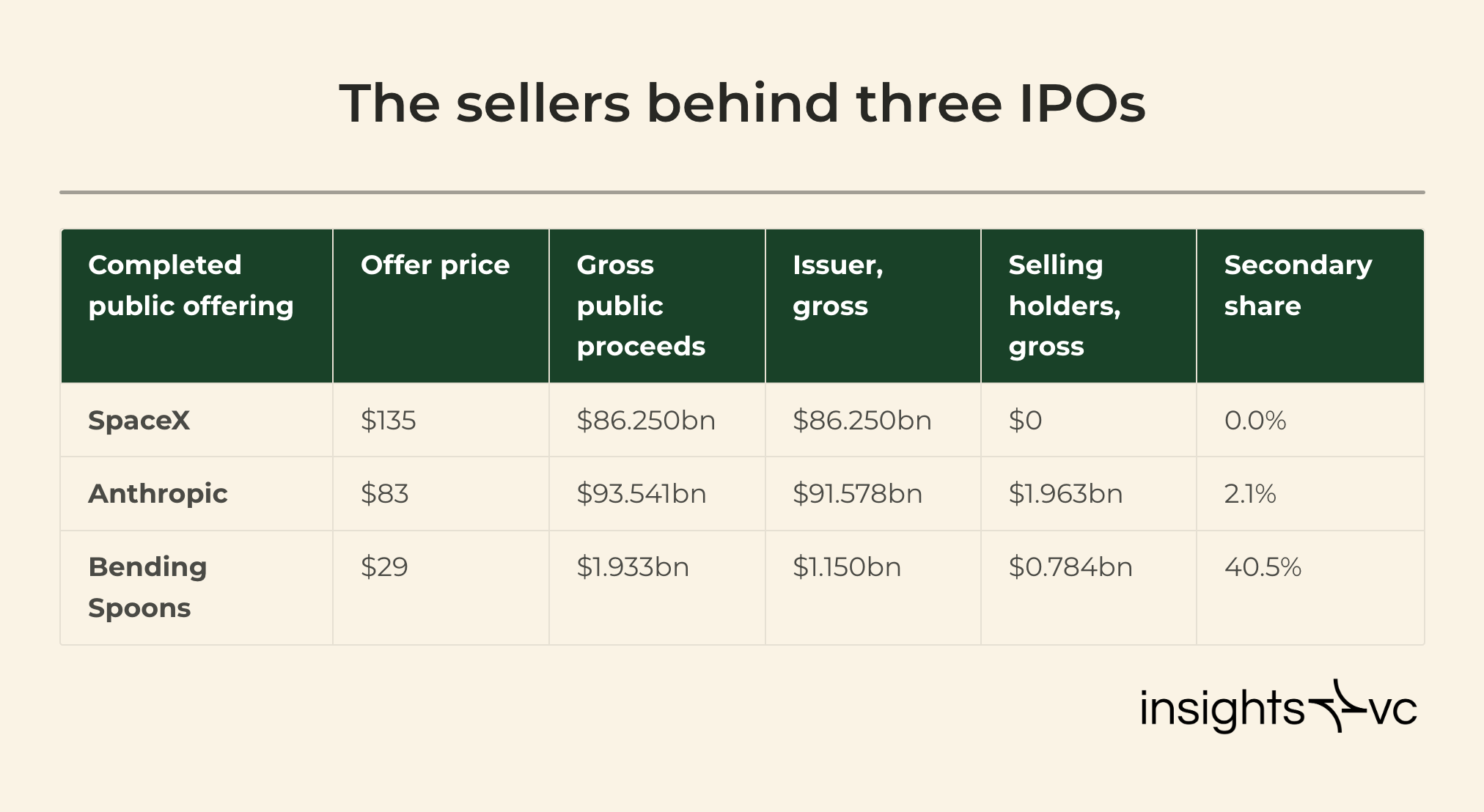
SpaceX and Anthropic sold nearly $180 billion of stock combined in their 2026 IPOs, but no venture capital fund sold shares in either offering. Before deducting underwriting fees, nearly $178 billion went directly to company balance sheets, while about $2 billion in secondary sales went entirely to the seven Anthropic founders (see Anthropic prospectus, Anthropic IPO completion announcement, and SpaceX offering documents).
The funding boom is also highly concentrated in other dimensions. According to Crunchbase, global VC investment rose $55 billion year-over-year in Q3, with AI companies accounting for roughly $50 billion of that. For LPs in older funds, distributions remain concerning: as of June 30, Carta tracking data shows the median 2017-vintage US VC fund had returned only $0.37 per $1 of paid-in capital (including cash and in-kind stock distributions).
This article examines what investors actually got from these blockbuster listings, how Bending Spoons is buying established software companies at prices far below historical valuations, why NVIDIA is investing heavily in its own customers, and the latest landscape in fintech and crypto. We will also track capital flowing into robotics, fusion energy, and defense technology, where new large checks are being used to purchase equipment, build factories, and assemble field deployment teams.
SpaceX, Anthropic, and Bending Spoons
SpaceX
On Nov. 14, SpaceX successfully caught the Starship upper stage returning from orbit for the first time. According to the Flight 15 mission announcement, the flight deployed 26 Starlink V3 satellites, which the company said added roughly the network capacity of 10 Falcon 9 launches with V2 Mini satellites.
The commercial value of this breakthrough lies in delivering higher bandwidth per launch and ultimately achieving full reusability of the launch vehicle. However, the Super Heavy booster was lost on the same mission, so the goal of recovering both stages in a single flight remains incomplete.
The added satellite capacity is feeding into an already profitable business: according to SpaceX's Q3 financial report, its Connectivity segment contributed $5.25 billion in revenue and $2.37 billion in operating profit in Q3. Yet the group's capital allocation extends far beyond satellites and launch vehicles.
Of the $48.1 billion in capital expenditures in the first nine months of 2026, $40 billion (83%) went to the "Super Intelligence" segment, which includes its AI infrastructure, Grok, Cursor, and X. The June IPO brought the company $85.7 billion in net proceeds. Investors therefore hold both a profitable connectivity business and an AI expansion that consumes the vast majority of the group's capex. Starship's progress strengthens the investment case for the former, while whether the much larger AI buildout can generate returns remains a separate test.
Anthropic
Anthropic's IPO and concurrent private placement, completed in November, raised approximately $117.6 billion in gross proceeds. Its seven selling founders cashed out about $1.96 billion (before taxes), while venture capital funds were entirely absent from the list of selling shareholders (see prospectus and official announcement). The vast majority of the deal's proceeds will support the company's next phase of growth, while immediate secondary liquidity went to the founders.
The prospectus reveals the practical rationale for such a massive raise. As revenue expanded rapidly on the back of pre-committed compute capacity, compute and infrastructure spending as a percentage of revenue fell sharply from 172% in the first nine months of 2025 to 57% in the same period of 2026. Nevertheless, Anthropic still spent $6.5 billion on short-term compute contracts, which the company said cost significantly more than comparable compute locked in through multi-year agreements.
This points to a clear use for the newly strengthened balance sheet: purchasing compute further in advance reduces reliance on expensive short-term supply. But it also shifts risk, as Anthropic must lock in infrastructure before demand materializes and then generate enough customer usage to absorb that capacity. The improving compute cost-to-revenue ratio shows the strategy is working, but maintaining the trend requires customer demand and contracted capacity to grow in tandem.
Bending Spoons
Bending Spoons has been acquiring mature software businesses at prices far below their earlier paper valuations, even as its own valuation climbs. The company was valued at $2.55 billion post-money in February 2024, and its pre-money valuation jumped to $11 billion in October 2025. At the $29 IPO price, total shares outstanding after full exercise of the over-allotment option imply an equity value of about $18.6 billion (see IPO prospectus).
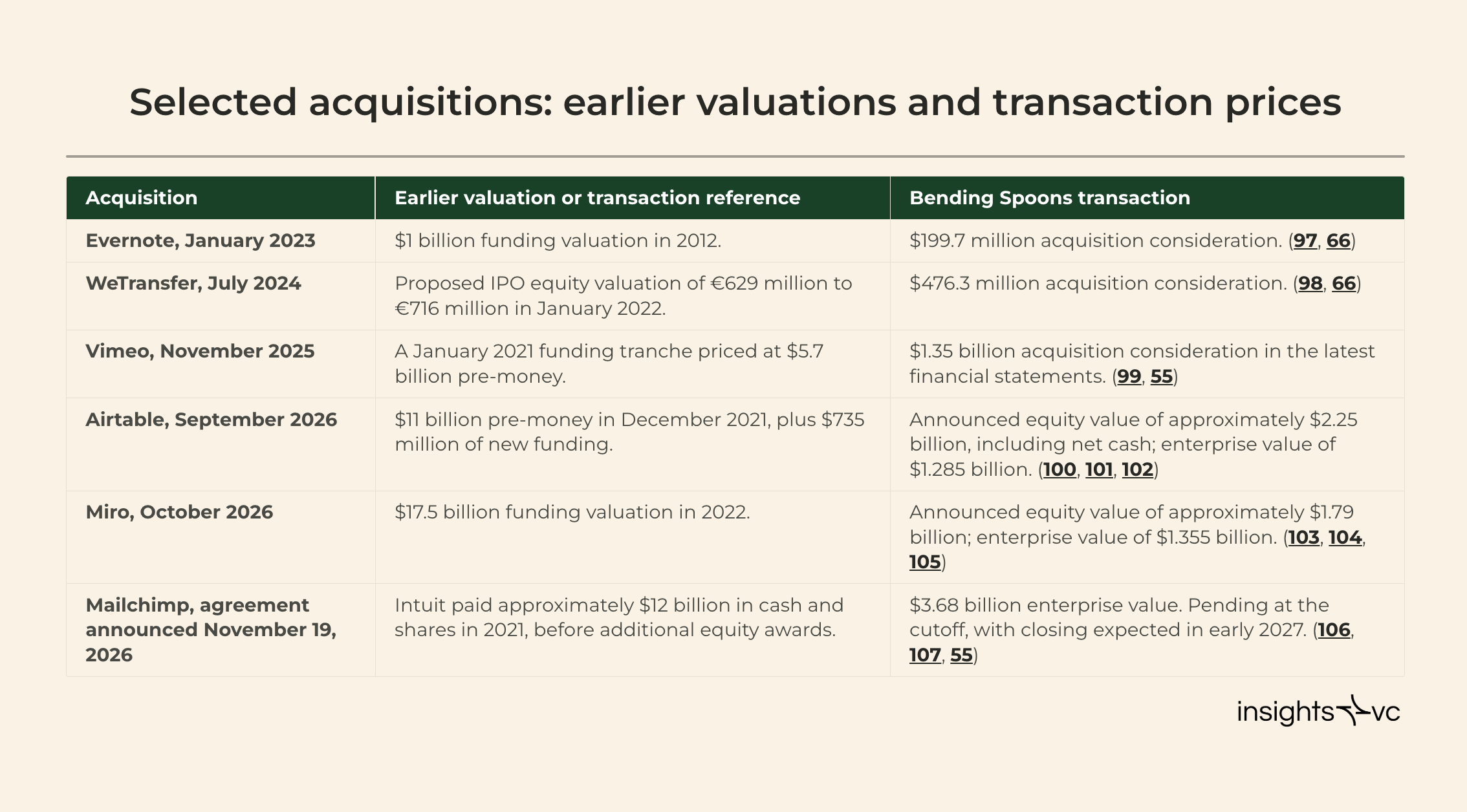
The Miro acquisition shows how M&A can provide liquidity while retaining some exposure to future growth. The announced equity value of the deal was about 90% below Miro's 2022 funding valuation, but some shareholders reinvested $295 million of their transaction proceeds into Bending Spoons at closing (see SEC filing).
Meanwhile, Bending Spoons' own IPO generated about $784 million in gross proceeds for selling shareholders, including $377 million for Galileo Quattordici and $237 million for funds managed by Baillie Gifford. Capital is flowing back to sellers through both M&A transactions and the acquirer's public listing.
The latest operating results reveal what Bending Spoons' new shareholders are buying into. According to the Q3 financial report, revenue surged 125% to $780 million, but the company-defined organic growth rate was only 3%. Despite $1.09 billion in net IPO proceeds, net debt stood at $4 billion as of Sept. 30.
These figures put acquisition pricing, operational improvement, and financing costs at the center of the investment thesis. Buying former unicorns at steep discounts creates opportunity, but ultimate returns still depend on post-acquisition profitability and cash flow.
AI Captures the Vast Majority of Funding Growth
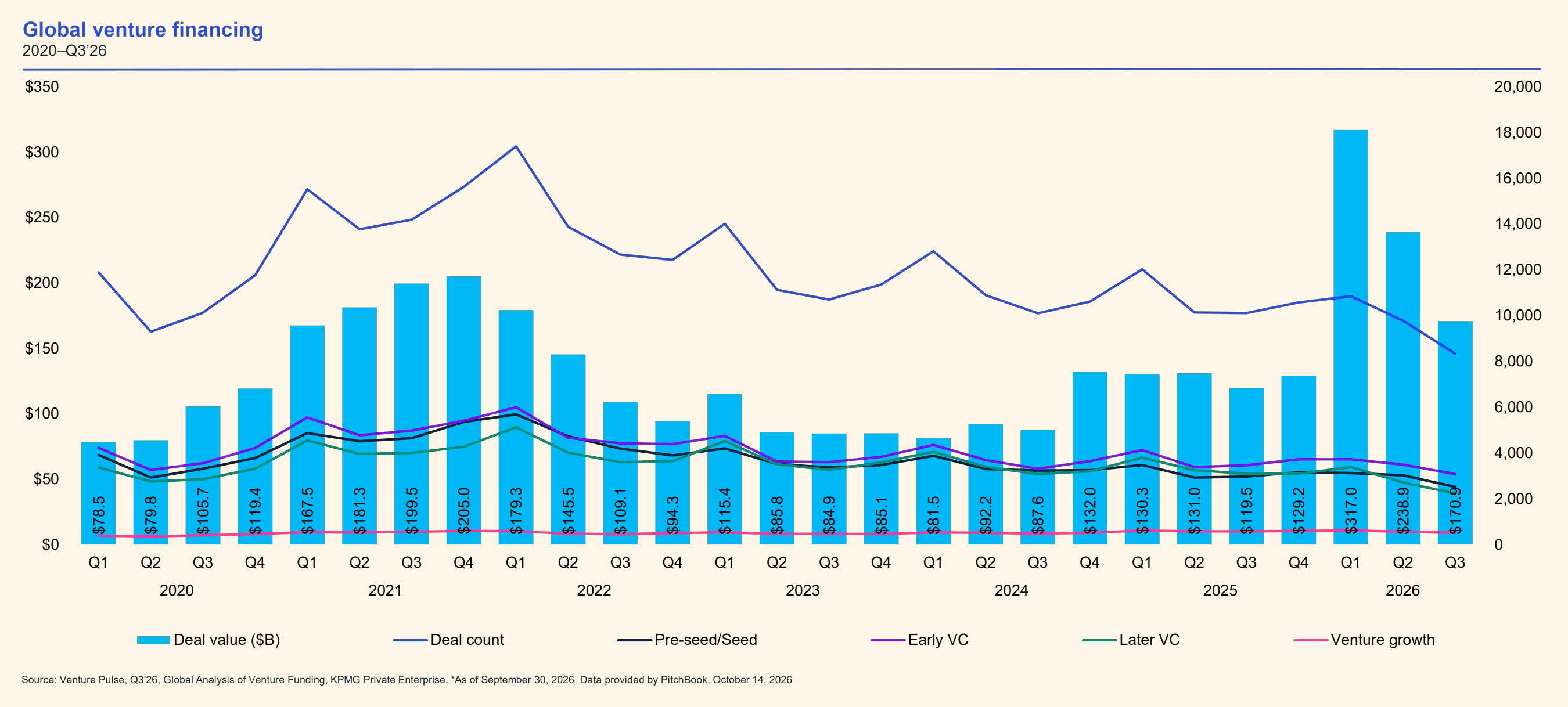
Chart: Quarterly VC investment falls from Q1 record peak
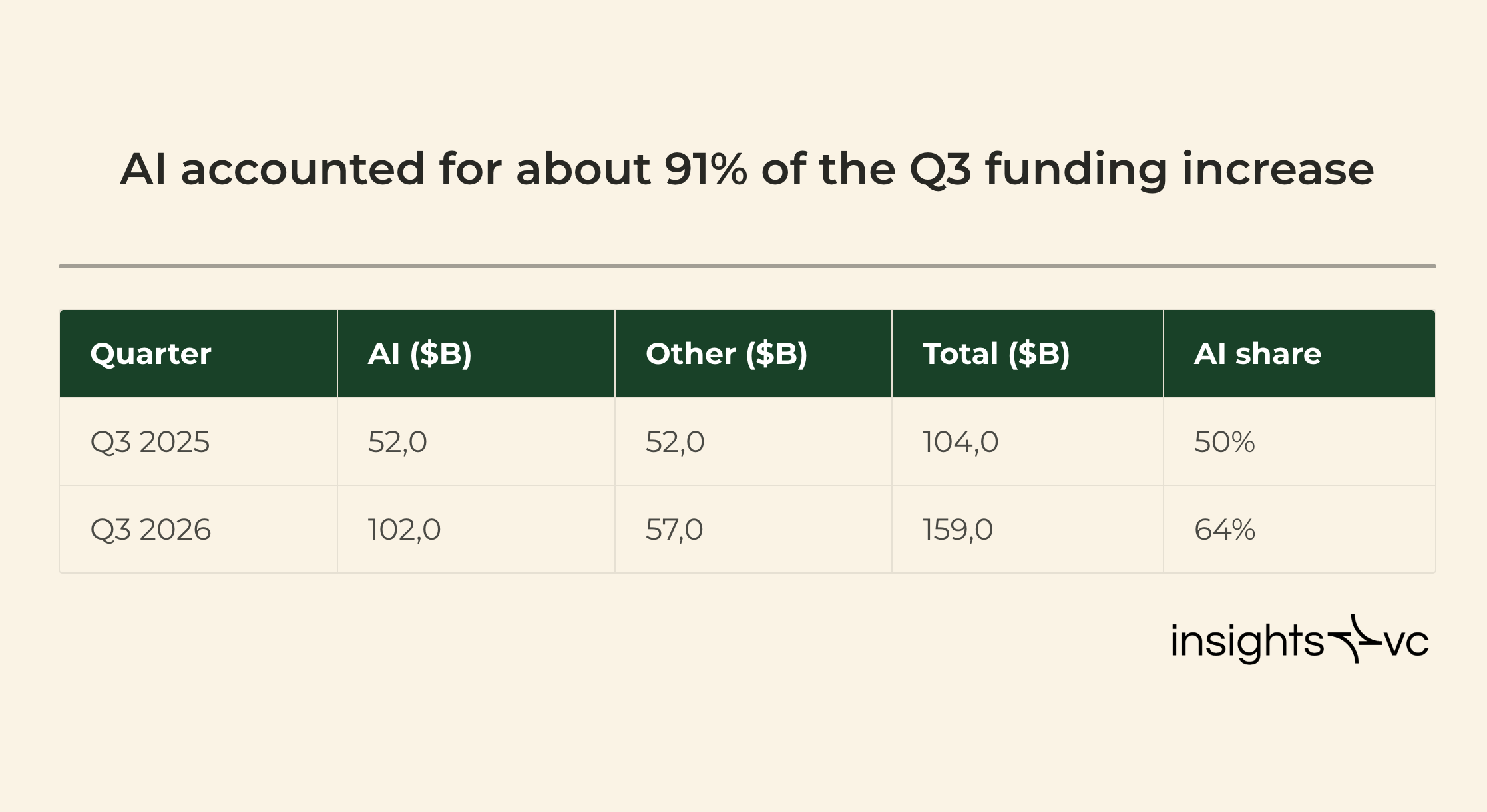
According to Crunchbase, global VC investment reached $679 billion in 2026 through the end of September. Q3 funding fell 25% quarter-over-quarter from Q2's $212 billion, but was still 53% higher than the $104 billion in the same period last year. AI's share of total funding climbed to 64%, up 14 percentage points year-over-year; after subtracting reported AI funding from the total, only about $57 billion remained for all other sectors.
October data further confirms the trend. On Nov. 3, Crunchbase disclosed that October global funding was $59 billion, up 45% year-over-year, with 66% classified as AI-related. DeepSeek's $15.9 billion round alone accounted for about 27% of the month's global total.
KPMG and PitchBook's Q3 Venture Pulse report counted 8,341 deals globally totaling $170.9 billion, up 43.0% year-over-year and down 28.5% quarter-over-quarter. The top five deals totaled $19.1 billion, and the top ten totaled $29.9 billion, or 17.5% of the quarter's total funding.
Even excluding the top ten deals from Q3 2026, the remaining funding of $141 billion still exceeded the $119.5 billion total for the same period in 2025. Note that this calculation excludes only the quarter's largest deals; it still includes AI funding outside the top ten and follows KPMG's practice of recording rounds at their announced sizes.
For example, the tally includes Crusoe's expected $3.9 billion Series F. But Crusoe's Form D filed on Sept. 17 shows actual sales of $3.109 billion as of that date, including previously issued SAFEs. The company disclosed contracted compute capacity of over 6 GW, but only 1 GW is operational, with most contracted capacity still to be built.
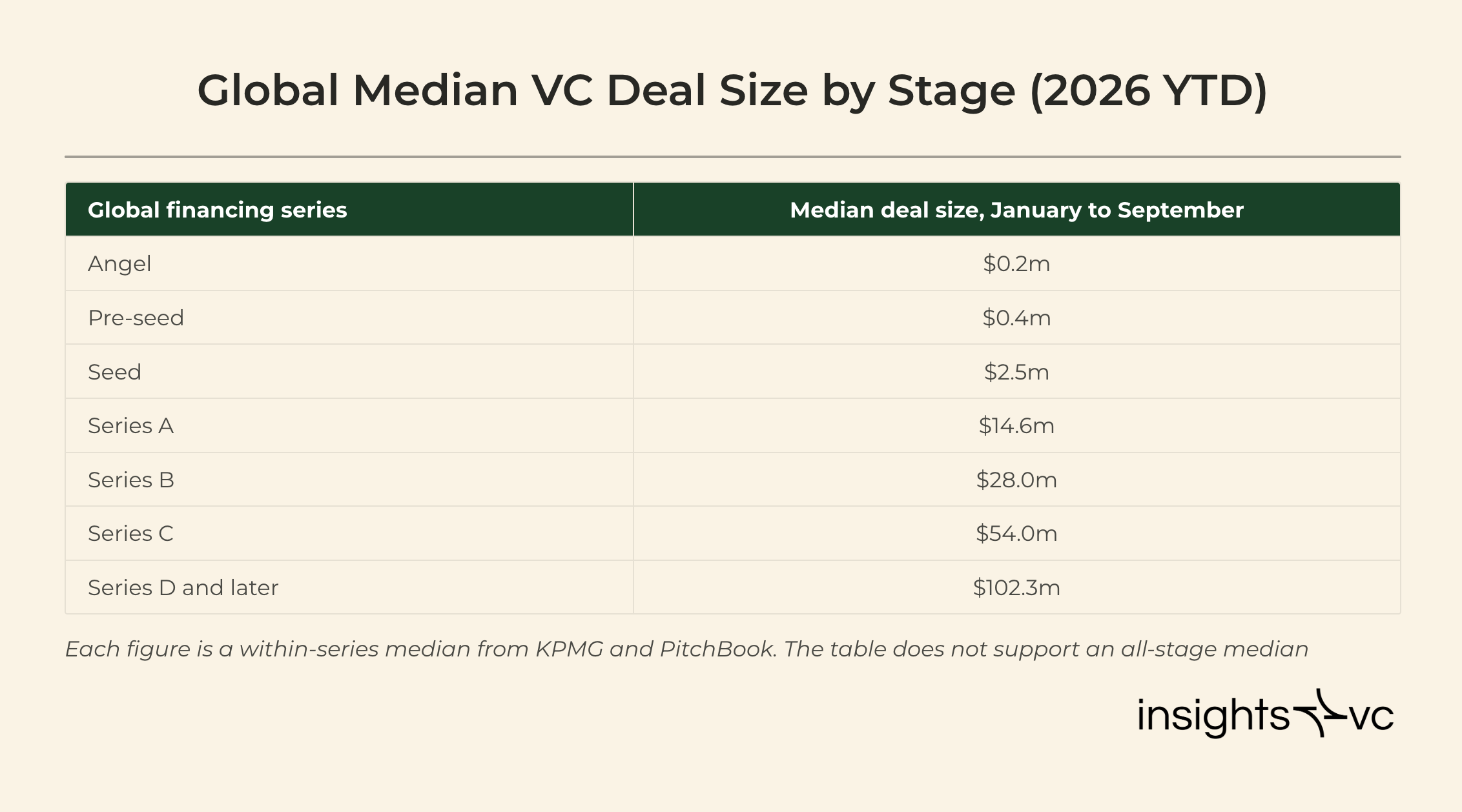
By stage, Crunchbase attributed $105 billion of Q3 to late-stage funding (up 73% year-over-year) and $40.6 billion to early-stage (up 25%). Of the $13 billion in seed funding, $2.6 billion went to mega-seed rounds of at least $100 million, accounting for one-fifth. KPMG's median global round size for the first nine months climbed from $400,000 at pre-seed to over $100 million at Series D and later.
How Much Money Is Actually Reaching Funds and Their LPs?
US companies received $515.8 billion in VC investment through the end of September. Over the same period, according to the PitchBook-NVCA Venture Monitor, 699 US VC funds that held final closes recorded only $108.5 billion in committed capital.
These two figures cannot be directly reconciled: PitchBook records commitments in the year of final close (even if LPs signed earlier); company funding can draw on older funds, foreign investors, or corporate balance sheets; and new fund commitments are called over multiple years.
Fundraising is highly concentrated at the top. Funds of $500 million or larger accounted for only 6% of closed funds but absorbed 78.1% of committed capital; 81 first-time funds together received only about 4.5% of commitments.
PitchBook recorded $23.8 billion in closes for Andreessen Horowitz (a16z) alone. In January, a16z announced $6.75 billion for its growth fund, $1.7 billion each for its applications and infrastructure funds, and $1.176 billion for its American Dynamism fund; on Aug. 31, it increased the total for its fifth growth fund to $8.5 billion (simply adding the January and August growth raises would double-count the first close).
Uncalled commitments from prior funds can still generate capital calls. PitchBook reported $278.5 billion in US VC dry powder as of Sept. 30, 2025; the $299.3 billion figure in the NVCA 2026 Yearbook has a date discrepancy (earlier Venture Monitor reports labeled that amount as of June 30, 2025). Neither observation represents the true uncalled capital at the time of this report.
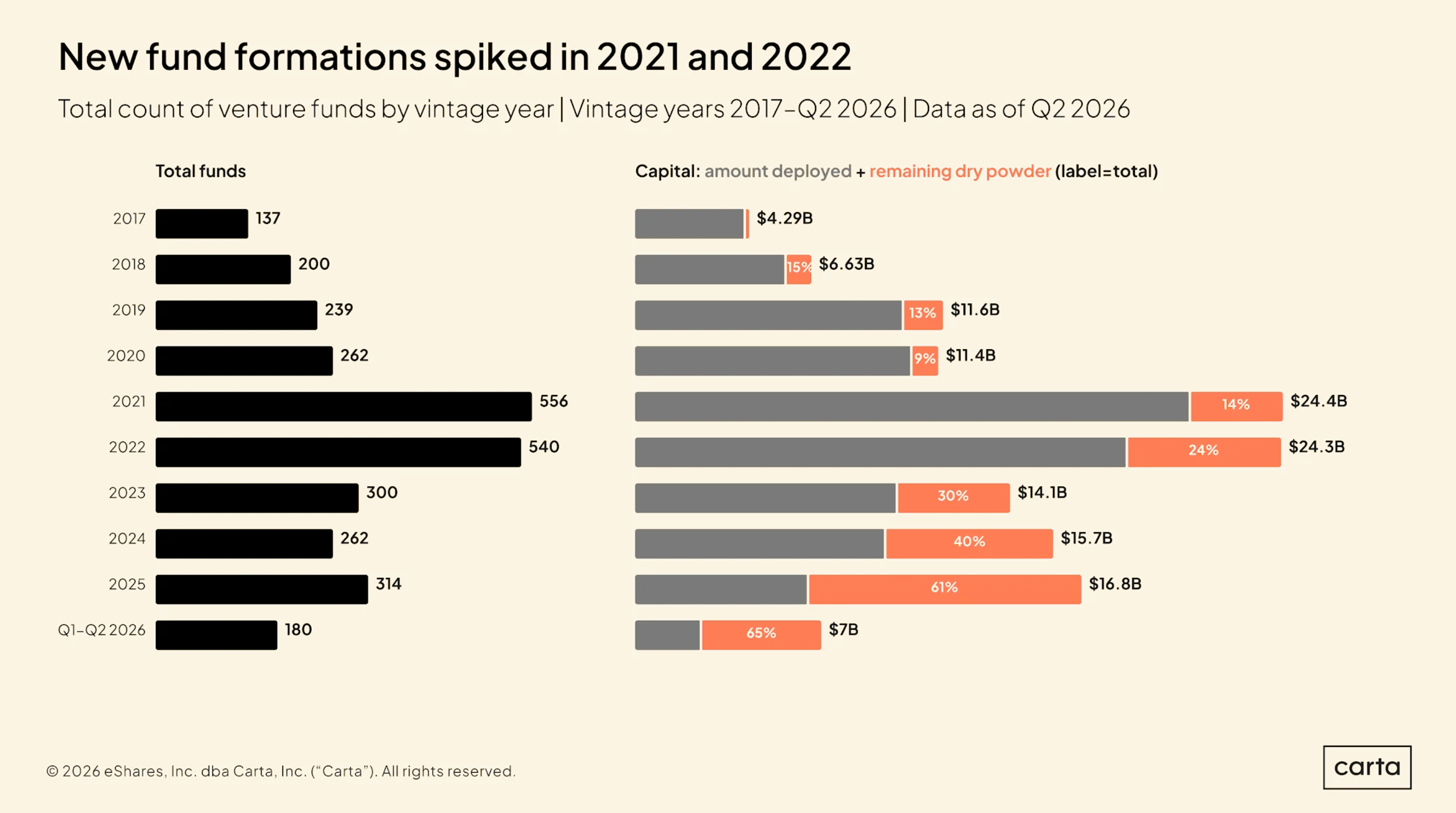
Return data is more sobering. As of June 30, Carta's median distributions to paid-in capital (DPI) for US VC funds were: 0.37x for 2017 vintages, 0.15x for 2018, and just 0.04x for 2019; the median net total value to paid-in capital (TVPI) for 2017 vintages was 1.72x.
DPI measures cumulative distributions per $1 of paid-in capital, while TVPI adds the book value of the remaining portfolio to distributions. Notably, distributions may include in-kind stock deliveries, and LPs receiving stock still need to sell in the secondary market to meet their own cash needs (see ILPA report definitions).
Carta's October deep dive offers a perspective that a single median cannot reveal: it calculated the share of realized value within each fund's total value. For 2017-vintage funds, the median realized ratio was 23.9%. Dividing 0.37 by 1.72 directly yields a different result because the two medians correspond to different funds. Carta's public cohort charts cover 137 funds from 2017, 200 from 2018, and 239 from 2019, but do not disclose how many samples underlie each median or how much was distributed in cash.
Canoe's Nov. 16 analysis of Q2 fund notices and statements shows cumulative distributions of $2.89 billion and paid-in capital of $1.92 billion in its VC sample, for net returned capital of $970 million. But across all VC strategies it tracks except venture debt, more funds called capital than made distributions, and the net positive capital returned came mainly from a few funds with large distributions.
Another liquidity channel is emerging in private markets. In the first half, Carta processed 71 private company tender offers totaling about $3 billion; Lazard estimated GP-led secondary transactions across private markets at $61 billion over the same period. Employees can cash out through tender offers, and LPs in continuation funds can choose to roll over or exit, but neither volume equates to actual cash distributions to VC LPs.
AI Funding Touches Both Ends of the Hardware Trade
In March, OpenAI announced $122 billion in committed capital at a post-money valuation of $852 billion; SoftBank's $30 billion investment was paid in three equal installments on April 1, July 1, and Oct. 1. On Nov. 6, Reuters reported that OpenAI completed a first close of about $11 billion in a new round at a $1.25 trillion valuation, but these latest terms are media-reported and the final size has not been officially confirmed.
In May this year, Anthropic also closed a $65 billion round at a $965 billion post-money valuation. Both mega-rounds were announced outside Q3, though one SoftBank installment fell within the quarter.
Anthropic's final prospectus disclosed Q3 revenue of $16.956 billion and compute and infrastructure spending of $9.863 billion. Annualizing Q3 revenue (multiplying by four) gives $67.824 billion, while actual revenue for the four quarters ended Sept. 30 was $35.282 billion. At a fully diluted equity value of about $1.5 trillion, these revenue denominators imply 22.1x and 42.5x price-to-sales multiples; at the $1.097 trillion base equity value implied by the reference price, the annualized Q3 revenue multiple is 16.2x.
Neither denominator represents full-year forecast sales. Anthropic also disclosed an annualized run-rate revenue metric as of Oct. 31, based on recent usage and subscriptions, of $81 billion. The company typically books compute 12 to 18 months in advance, meaning a demand slowdown after capacity is locked in would create significant exposure.
At the other end of the hardware supply chain, NVIDIA bought $2 billion of CoreWeave common stock at $87.20 per share in January. Its 13F filing in November showed 47.2 million CoreWeave shares held as of Sept. 30, worth $4.11 billion (the total includes shares purchased at other times). NVIDIA is both supplier and shareholder to this publicly traded cloud compute operator; if customer demand falters, it would hit both hardware orders and the value of its equity stake.
Across the group, according to NVIDIA's supplementary financial information, in the nine fiscal months ended Oct. 25, NVIDIA spent $58.1 billion on equity securities, up from $4.952 billion a year earlier. Its non-marketable equity balance surged from $22.251 billion to $61.65 billion, with net new investments contributing $46.436 billion, unrealized gains $8.308 billion, reclassifications reducing it by $13.349 billion, and impairments and losses reducing it by $1.996 billion. In addition, three direct customers accounted for 36% of NVIDIA's revenue in the third fiscal quarter, but the financial report did not disclose the end users behind those sales.
As of Oct. 25, NVIDIA also disclosed $20 billion in future equity investment commitments and up to $32 billion in contingent agreements with cloud operators (subject to financing, deployment, and equipment acceptance conditions). Separately, Ohio lease guarantees could total up to $105 billion as data center buildings come online (first expected in fiscal 2029), with no guarantee payments made to date. NVIDIA's additional $10 billion subscription in Anthropic's private placement falls in November. Simply adding these figures into a single "total investment" would conflate historical cash outlays with contingent future exposures.
On corporate governance, NVIDIA's board accepted Jensen Huang's resignation as president, CEO, and director on Nov. 11, and appointed CFO Colette Kress as interim CEO, with the company announcing the change on Nov. 12. Then on Nov. 22, the board reinstated Huang to all three roles and disclosed the move on Nov. 23, with Kress remaining CFO. Both changes occurred after the October financial reporting cutoff.
Fintech Deal Count and Crypto Funding Size
According to Crunchbase, global fintech recorded 687 deals totaling $10.64 billion in Q3, compared with about $13.5 billion across 995 deals a year earlier. By these figures, despite total funding falling about 21% and deal count plunging 31%, the arithmetic average deal size actually rose from $13.6 million to $15.5 million.
Year-over-year, total funding for rounds under $100 million fell 31.4%, while rounds of $100 million or more fell only 7%. Compared with Q2, large rounds accounted for about 92% of the quarter-over-quarter decline in total funding based on published rounded figures (Crunchbase reported about 93%).
However, industry definitions matter greatly here. FinTech Global's November review recorded 897 deals totaling $27.4 billion, up 35% year-over-year, but its scope includes enterprise cybersecurity company Island. The two data providers are effectively tracking different company samples.
Within the Crunchbase dataset, Ant International's $1.2 billion Series A accounted for most of Singapore's $1.28 billion in Q3 fintech funding; Saudi payments company barq raised $329.5 million, and Indonesian investment platform Ajaib raised $270 million.
Earlier this year, TCV led Mercury's $200 million Series D at a $5.2 billion valuation; in January, ICONIQ led a $250 million round for stablecoin payments infrastructure Rain, and payments network Mesh raised $75 million. Every dollar flowing into stablecoin payment rounds may be classified as both fintech and crypto depending on the data provider.
In software for finance teams, Accel led Basis's $100 million Series B, after which audit and advisory firm Baker Tilly designated Basis to provide reconciliation and journal entry support, among other services. On the other hand, Unit21 is selling AI tools for investigating fraud and AML alerts, but its product launch announcement did not quantify missed-report rates, time saved, or customer margin improvements.
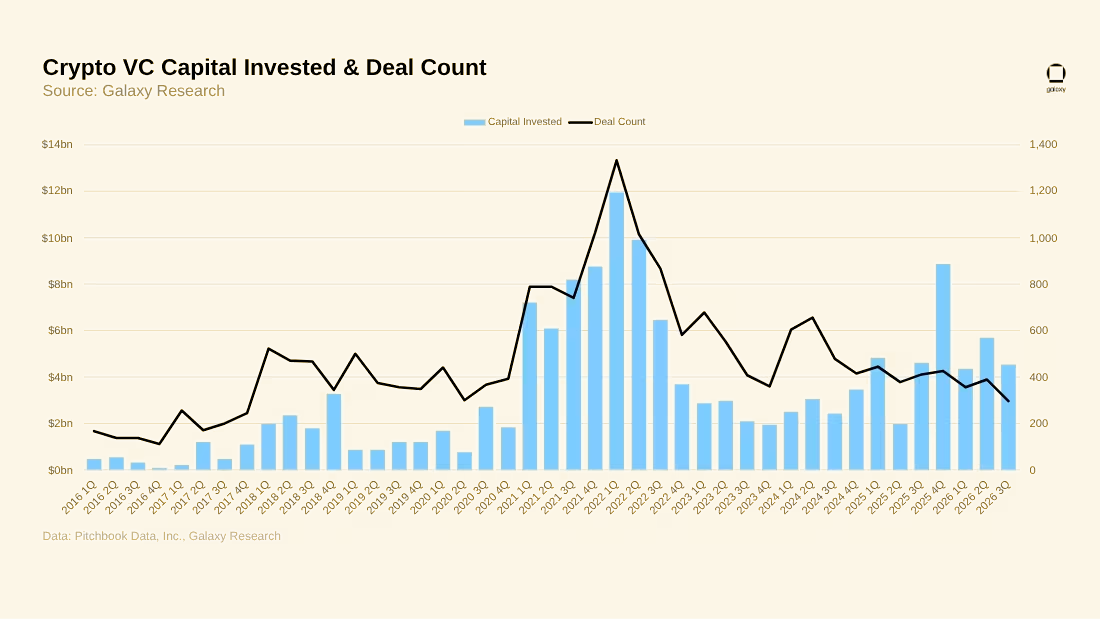
In crypto, according to Galaxy, global crypto and blockchain VC completed 296 deals totaling $4.519 billion in Q3; its Q2 report showed 384 deals and $5.683 billion. By these figures, funding fell 20.5% quarter-over-quarter and deal count fell 22.9% (the Q3 report text says deal count fell 24% but does not provide a revised Q2 denominator).
By sub-sector, trading, exchanges, investing, and lending took $2.37 billion across 34 deals, an average of $69.7 million per deal; the remaining 262 deals averaged just $8.2 million, and Galaxy's market-wide median was about $3 million. Over 90% of trading-sector funding went to late-stage companies; by deal count, payments and rewards led with 38 deals, ahead of trading's 34 and DeFi's 31.
Sectors Accelerating in 2026
Construction robotics attracted $1.6 billion in funding in 2026 through Oct. 29, more than four times the $389 million for all of 2025 (see Crunchbase category snapshot). But the number of rounds only edged up from 28 to 30, showing the acceleration is driven by large bets on a few companies.
The demand logic is straightforward: contractors facing skilled labor shortages need to squeeze more output from existing equipment. Bedrock's $600 million round in October followed its autonomous excavators starting paid construction work in August. The company's next spending priority is building deployment teams and field operations infrastructure—the foundation needed to run autonomous equipment reliably across multiple sites. This also gives investors a clear test: whether a successful single-site deployment can become a repeatable service that contractors will keep paying for.
Fusion energy saw significant jumps in both total funding and large deals. According to Dealroom, VC funding in the sector reached $4 billion through Oct. 6 (versus $2.1 billion for all of 2025), with 11 rounds of $100 million or more, up from 5 a year earlier.
Commonwealth Fusion Systems' $1 billion equity round in July drew pension funds, sovereign wealth funds, and strategic investors to support its demonstration device and planned commercial fusion power plant. Google and Eni have signed agreements to lock in more than half the output of the planned ARC plant (CFS expects to begin delivering power in the early 2030s). While clear future power buyers have emerged in the investment thesis, raising capital and solving engineering challenges years before power sales generate revenue remains the core challenge.
AI expansion is also channeling capital into grid hardware and optical interconnects, targeting two physical bottlenecks: delivering power to compute equipment and moving data between processors at high speed. Through mid-year, PitchBook recorded the strongest two consecutive quarters for grid technology investment since the 2021 peak. Heron Power closed a $140 million Series B, after which Vantage booked power conversion equipment for over 1 GW of capacity.
In optical interconnects, Ayar Labs raised $650 million in 2026, while Lumilens announced over $700 million in new funding and said its first products have begun shipping to AI data centers entering production. These suppliers benefit from infrastructure spending by multiple large model developers and cloud operators, and their economic value lies in accelerating compute deployment and improving how efficiently expensive chips work together, making production ramp and customer qualification the keys to investment success.
Defense technology, under PitchBook's broad definition, absorbed $77.5 billion through the end of September, 36.8% higher than all of 2025 (see PitchBook Q3 defense tech report). Even excluding Blue Origin's $10 billion round, Q3 investment still hit a record $27.9 billion. The report notes that beyond record funding for missiles, munitions, and hypersonic weapons, capital commitments for capacity expansion are also rising.
Quantum Systems' October announcement illustrates the underlying demand: the German government will fund the purchase of tens of thousands of interceptor drones for Ukraine, scaling up production of systems already deployed in combat. For investors, this creates opportunities in manufacturing and component supply chains beyond autonomous control software. Government procurement provides a clear buyer, while production ramp speed, reliability, and delivery timelines determine how much real demand young companies can capture.
Conclusion
Most of the capital raised in 2026 is being used to fund the next phase of business expansion, while established VC funds are still struggling to return cash to their LPs. IPOs have reopened the liquidity path, and M&A has provided exits for some companies, but deal prices are often far below earlier funding valuations.
Meanwhile, the massive commitments flowing into robotics, energy, and defense will test VC firms' ability to finance manufacturing and physical delivery over longer cycles. For LPs, the clearest signal of whether the market will see a truly broad recovery in 2027 will be more funds across different vintages resuming cash distributions, freeing up room for a new round of capital commitments.
This content is for informational and educational purposes only and does not constitute investment advice related to BTCC. BTCC makes every effort but cannot guarantee the truthfulness, accuracy, or originality of the content above.