After Being Crushed by Leverage, the 'AI Stock God' Changed His Betting Strategy
 Odaily
Original | Odaily News (@OdailyChina)
Author | Azuma (@azuma_eth)
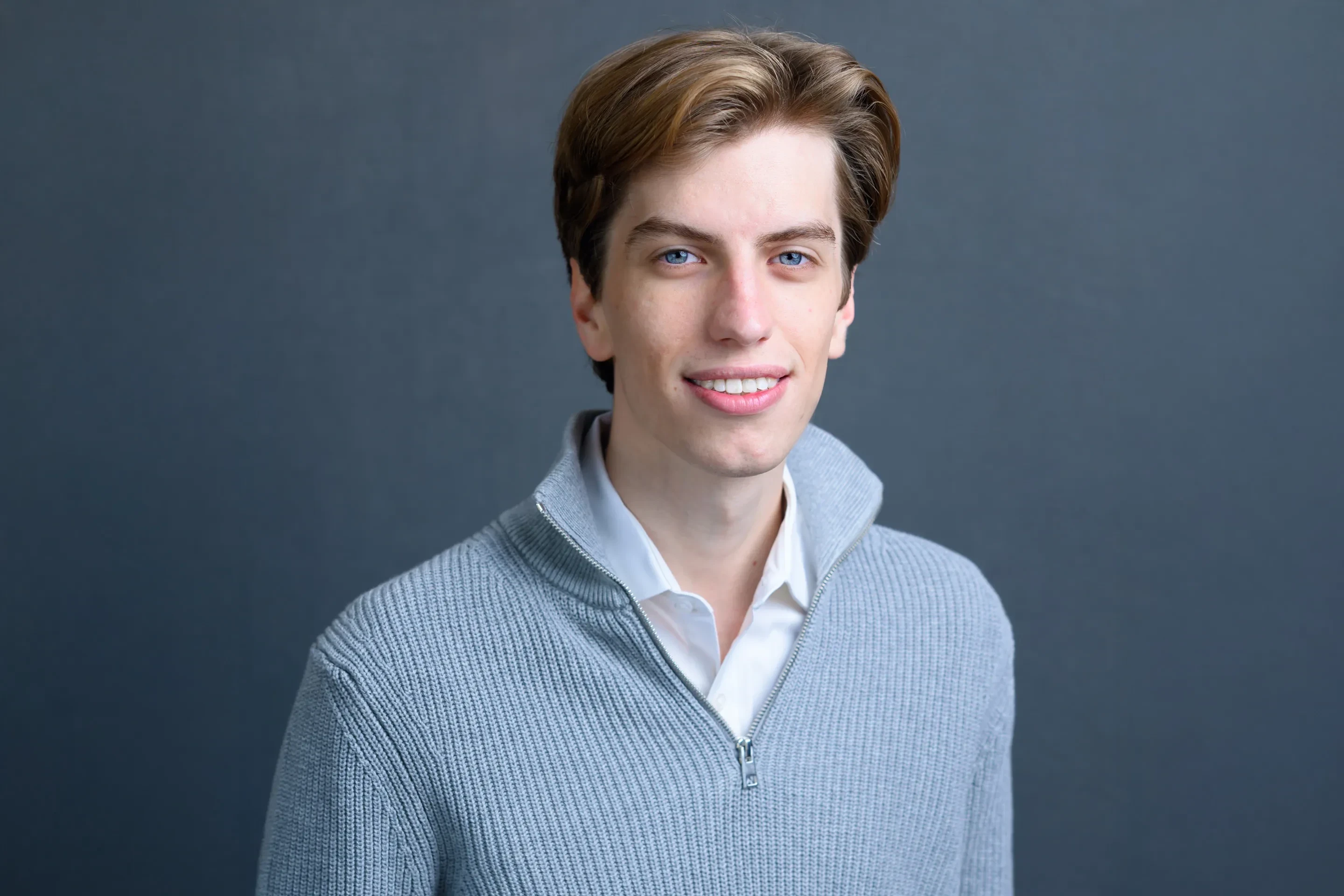
This summer, Leopold Aschenbrenner, the "AI Stock God" once hailed by Wall Street as a new investment legend, and his fund Situational Awareness LP, experienced a dramatic rise and fall worthy of the investment history books.
In our Q1 and Q2 13F tracking reports, we witnessed how he pushed the fund's public holdings to a peak of over $20 billion through extreme bets on AI infrastructure (storage, power, computing). However, shortly after the end of the Q2 reporting period, the sharp correction in the AI sector in July, combined with excessive leverage, dealt a heavy blow to Situational Awareness. Leopold was ultimately forced to cut his losses and sell the vast majority of his public equity portfolio at a discount to Citadel, led by Ken Griffin.
The story did not end there. In September this year, sources revealed that Leopold had returned to the investment battlefield. During the recent sharp market correction, rumors even circulated that Leopold had suffered a "second blow-up" — unconfirmed, with many details based on the now-outdated Q2 holdings report — but since the Q3 13F had not yet reached its disclosure window, outsiders could not glimpse the true hand of this former legend after the July disaster.
On November 17, Taipei time, Situational Awareness finally submitted its 13F holdings report to the U.S. Securities and Exchange Commission (SEC) for the period ending September 30, 2026. This long-awaited report card finally reveals his current positioning.
Who is the "AI Stock God"? (Skip if familiar)
Leopold worked at FTX's Future Fund starting in 2022 and remained with the team until FTX's collapse. In 2024, Leopold wrote a 165-page mega-paper titled "Situational Awareness: The Decade Ahead" and founded the eponymous fund Situational Awareness in the same year, serving as its chief investment officer.
Situational Awareness focuses on investment opportunities in the AI industry chain. The fund's public holdings were "only" $225 million in Q4 2024; by the Q4 2025 disclosure released in February this year, that figure had rapidly grown to $5.5 billion; by the Q1 disclosure in May, it had risen to $13.7 billion; and in the Q2 disclosure, it peaked at $20.2 billion... but now those numbers are meaningless.
- Odaily note: It is important to note that in the statistical scope of U.S. stock 13F filings, the market value of option assets is typically shown as the "notional value" of the underlying stocks, rather than the actual premium cost paid by the fund.
With explosive investment returns, Leopold and Situational Awareness gained widespread fame, becoming one of the most closely watched AI investment indicators on the internet. Leopold was also dubbed the "AI Stock God" by a market eager to create idols.
Holdings Shrink 92%: From $20.2 Billion to $1.58 Billion
In terms of fund size, after the "discount fire sale" in July, Situational Awareness's holdings have shrunk dramatically.
According to the latest Q3 13F filing, as of September 30, 2026, Situational Awareness's disclosed 13F holdings value plummeted from approximately $20.24 billion at the end of Q2 to approximately $1.58 billion, a single-quarter decline of 92.2%.
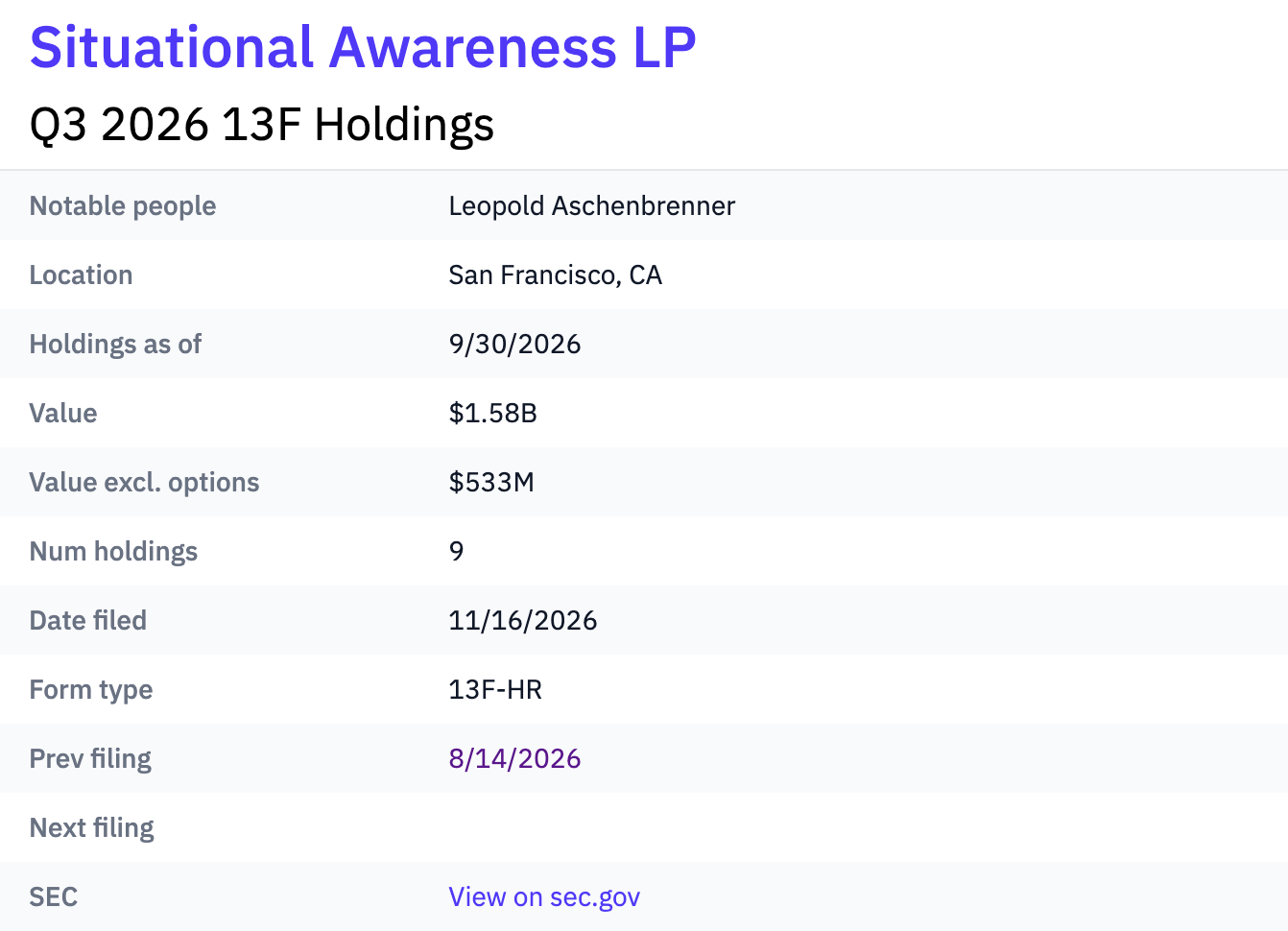
Breaking down the holdings structure further makes this change even more apparent:
- Excluding options, the value of common stock holdings shrank drastically: At the end of Q2, the fund held as much as $20.17 billion in common stocks; by the end of Q3, the total value of its common stock holdings was only $533 million, a 97.4% reduction.
- Holdings were extremely streamlined: The number of holdings was cut from 42 in Q1 and 26 in Q2 to just 9 in Q3.
- Top five positions accounted for 94.2% concentration: Of the $1.58 billion total notional exposure, the top five positions contributed approximately $1.485 billion, or 94.2% of the entire portfolio.
In short, after surviving the July liquidation crisis, Situational Awareness is no longer a multi-billion-dollar giant covering multiple sectors and dozens of holdings in the secondary market. Instead, it has significantly reduced its fund size and concentrated its remaining capital in a few core positions.
Core Holdings Breakdown: Full Shift to Options, SHAZ Becomes the Only Major Common Stock Holding
What did Leopold buy back with the $1.58 billion in total notional holdings?
The answer remains his most familiar formula — AI computing cloud, data center power, and AI storage; however, Leopold's specific trading approach has changed significantly — from "heavily accumulating common stocks" to "positioning in call options."
In the Q2 report, 99.6% ($20.17 billion) of Situational Awareness's $20.24 billion holdings were actual stock positions, with just two storage giants, SanDisk (SNDK, 28.0%) and Micron (MU, 27.5%), accounting for half of the portfolio. In the Q3 report, the proportion of common stocks was compressed to only 33.7% (approximately $533 million), while the remaining 66.3% (approximately $1.047 billion) of notional exposure consisted entirely of call options.
Below is the detailed core holdings of Situational Awareness as of the end of Q3 2026.
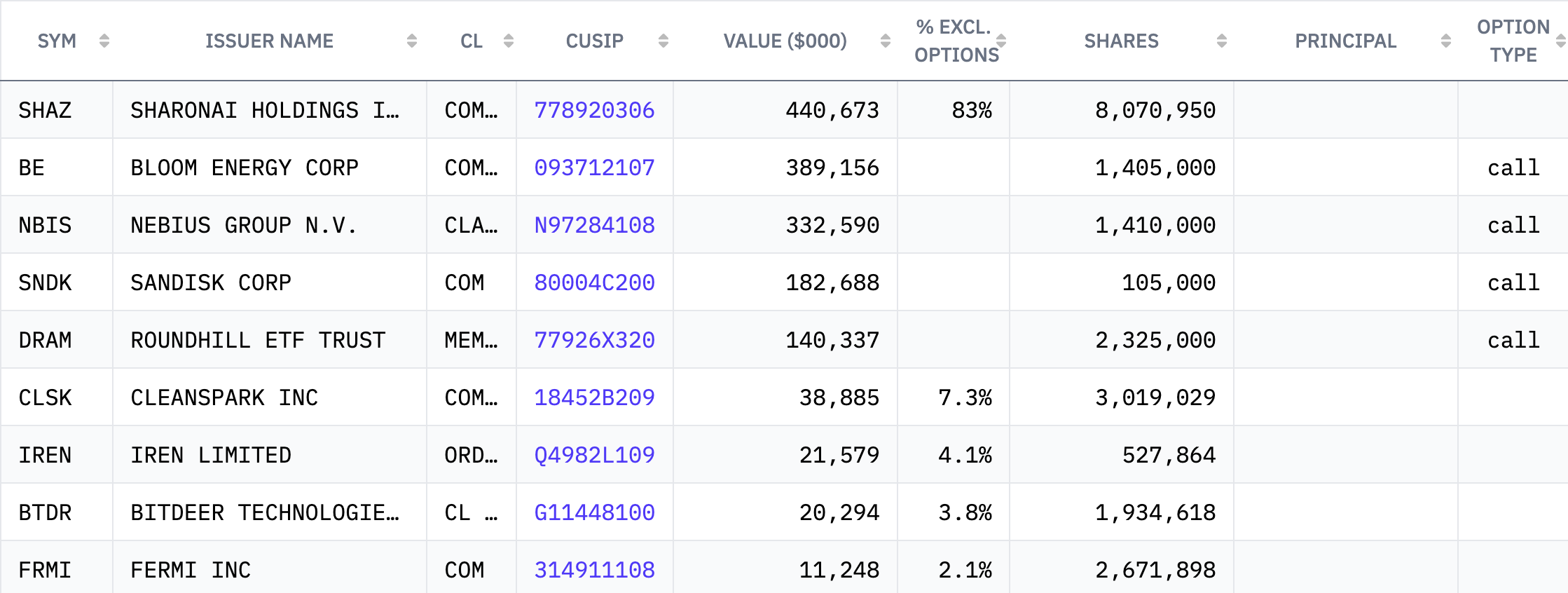
Specifically, the top five holdings in Q3 (combined 94.2%):
- Largest holding: SharonAI (SHAZ) common stock, with a market value of approximately $441 million, accounting for 27.9%. This is the fund's only major common stock holding. Situational Awareness now holds over 21% of the outstanding shares of this Australian AI computing cloud service provider.
- Second largest: Bloom Energy (BE) call options, with a notional value of approximately $389 million, accounting for 24.7%. The logic of betting on data center power bottlenecks continues, but the position has been switched from common stock in Q2 to call options.
- Third largest: Nebius Group (NBIS) call options, with a notional value of approximately $333 million, accounting for 21.1%. Also a representative of the emerging computing cloud (Neocloud) that Leopold has long favored, with call options used in Q3 to maintain high exposure.
- Fourth and fifth largest: SanDisk (SNDK) call options, with a notional value of approximately $183 million, accounting for 11.6%; Roundhill Memory ETF (DRAM) call options, with a notional value of approximately $140 million, accounting for 8.9%. In the core storage sector, Leopold cleared his Q2 common stock positions in Micron (MU) and SanDisk (SNDK), instead using SNDK call options combined with memory industry ETF (DRAM) call options to continue betting on the storage cycle upturn.
Apart from the top five, Situational Awareness also holds small amounts of common stock in CleanSpark (CLSK), Iren (IREN), Bitdeer (BTDR), and Fermi (FRMI). The first three were significantly reduced, while FRMI is a new position this quarter.
Has Leverage Been Reduced?
After the massive losses in July, did Leopold reduce leverage?
Although 13F filings do not directly disclose the fund's margin debt borrowed from prime brokers, the change in leverage structure is clearly visible through the switch in holding instruments — using the "implicit leverage" inherent in options to replace the "explicit financing leverage" that triggers forced liquidation.
In other words, the 13F does not disclose Situational Awareness's actual leverage ratio, but the market at least sees that the fund's risk structure has changed.
After the huge losses in July, Leopold stated in a letter to investors that the fund had deleveraged its portfolio. When re-entering the market in September, sources also revealed that he had switched to fully paid option trading to avoid the risk structure that relied on financing and was prone to margin calls.
Looking at the Q3 13F, the four call options disclosed (BE, NBIS, SNDK, and DRAM) have a combined notional value of approximately $1.045 billion, accounting for about two-thirds of total holdings. It is important to note that this $1.045 billion is not the actual premium paid, but the notional value of the underlying stocks (since the 13F does not disclose the specific strike prices, expiration dates, or purchase costs of the options, we cannot accurately calculate how much principal the fund paid for these positions). If these positions are call options fully purchased with own funds, then a decline in the underlying typically does not directly trigger a margin call like buying stocks on margin, and the maximum loss is essentially limited to the premium paid.
This does not mean the risk has disappeared. Call options still face underlying price declines, time value decay, and changes in implied volatility, but at least they will not push Leopold back into the predicament of July. Previously, Situational Awareness was forced to sell at a discount to Citadel precisely because borrowing money to buy stocks triggers margin calls and cascading forced liquidations during a crash. By switching to directly buying call options, this structure does not have a margin call mechanism, and the maximum loss is locked in at the moment of purchase as the premium paid — considering the market's recent sharp decline again, this may help Leopold dodge another bullet.
Leopold Remains Bullish on AI, Just Changed His Approach
Looking at this Q3 13F, it is clear that Leopold's conviction has not changed, but his investment style has shifted significantly — Leopold is still a steadfast AI bull, but after the July debacle, he has begun to add a safety cushion to his aggressive investment style.
However, this 13F only records holdings as of September 30 and cannot reflect trading changes over the past month and a half. After the recent market weakness, whether Leopold has reduced positions, stopped losses, or even faced new liquidity pressure remains to be verified by subsequent information.
In July, Leopold lost to leverage; now, he is trying to regain the initiative with options. But this time, whether he can survive until the AI investment thesis plays out remains an unknown.
This content is for informational and educational purposes only and does not constitute investment advice related to BTCC. BTCC makes every effort but cannot guarantee the truthfulness, accuracy, or originality of the content above.