


Gold Breaks Below $4,300 as Macro Pressure Builds; BTC Holds $77K
 BTCCAuthor: Harvey
👉 Try Copy Trading & Get 50 USDT
On September 2, the U.S.-Iran conflict escalated again, sending international oil prices sharply higher while the U.S. dollar and Treasury yields strengthened in tandem. Stocks, gold, and crypto assets broadly came under pressure. Spot gold briefly fell below $4,300, while BTC dipped below $77,000 before quickly recovering back above the level.
Oil, the Dollar, and Treasury Yields All Rise
The U.S. and Iran clashed again, with both sides sending strong signals and fueling concerns over potential disruptions to energy supplies. WTI crude climbed back above $90, while Brent crude rose above $95. The sharp rise in oil prices reignited concerns over energy inflation.
Combined with Federal Reserve Chair Kevin Warsh’s earlier hawkish remarks at Jackson Hole, market expectations for a September rate hike have risen to around 68%. The risk of interest rates remaining elevated or moving even higher has once again become an important factor in global asset pricing.
The U.S. dollar and Treasury yields strengthened accordingly. The U.S. Dollar Index rose 0.25% to 99.7, while the 10-year U.S. Treasury yield climbed to 4.812%, its highest level since late 2023.
Gold and U.S. Stocks Fall Together
All three major U.S. stock indexes declined on Tuesday. The Dow fell 0.79%, the Nasdaq dropped 1.03%, and the S&P 500 lost 0.71%. Technology stocks came under notable pressure, with Nvidia down 1.5% and AMD falling 2.4%, while Tesla, Microsoft, and Micron also broadly pulled back. Rising oil prices pushed inflation expectations higher, while higher Treasury yields weighed on valuations, putting technology stocks and high-beta growth assets under the greatest pressure.
The market’s approach to pricing AI and technology stocks has returned to the question of whether high growth can offset the impact of high interest rates. If Treasury yields continue to rise, capital could continue to rotate out of long-duration growth stocks. If Friday’s nonfarm payrolls report shows a cooling labor market, however, rate pressure could ease.
During Asian trading on September 2, Japanese and South Korean equities closed sharply lower. The Nikkei 225 fell around 3% on the day, while South Korea’s KOSPI dropped around 4%. SK Hynix and Samsung Electronics both fell more than 4%.
Traditional safe-haven gold also failed to benefit from geopolitical risks. Spot gold briefly fell below $4,300, suggesting that the current market move is being driven more by the U.S. dollar, real yields, and energy inflation than by geopolitical safe-haven demand alone.
BTC Recovers After Falling Below $77K, Showing Near-Term Resilience
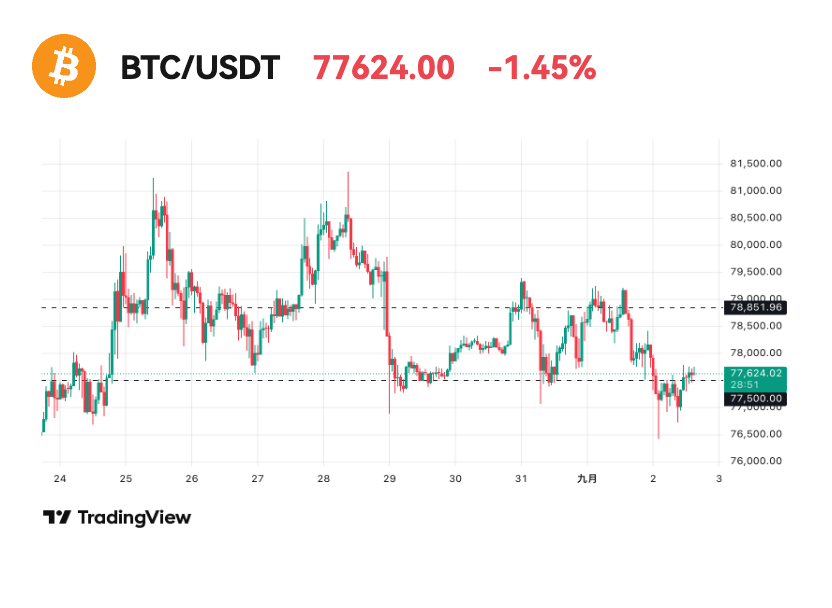
Compared with gold, Bitcoin posted only a modest decline. According to BTCC market data, BTC was trading at $77,624, down 1.45% over the past 24 hours. BTC briefly fell below $77,000 before quickly rebounding toward $77,500. The price remains within the $76,000–$79,000 range. Short-term volatility has increased, but there has yet to be a major technical breakdown.
👉 Try Copy Trading & Get 50 USDT
Technically, $76,500–$77,000 is the first key support zone. If this area fails to hold, BTC could further test $75,000–$75,700. On the upside, BTC needs to reclaim $78,500–$79,200 before another attempt at $80,000–$81,000 becomes possible.
ETF flows have diverged again. On September 1, U.S. spot Bitcoin ETFs recorded combined net outflows of $236.5 million, bringing net outflows over two consecutive days to $436 million. Meanwhile, spot Ethereum ETFs recorded $8.6 million in net inflows yesterday, extending their net inflow streak to 12 days.
Overall, BTC has avoided a deep pullback despite rising macro pressure, with prices remaining relatively stable. However, weaker short-term demand and a stronger U.S. dollar are contributing to increased near-term market volatility.
ETH Retests $2,400 as UNI and ARB Rise Against the Market
ETH fell more sharply than BTC, reaching an intraday low near $2,386. Although ETF flows remain relatively strong for ETH, macro risk aversion and the reduction of high-beta positions have limited its near-term rebound.
Technically, $2,380–$2,400 is the key short-term support zone for ETH. If this area holds, ETH could retest $2,480–$2,500. If it falls below $2,380, attention may shift to the $2,300–$2,350 support zone.
Among altcoins, the market remains dominated by selective rotation. UNI gained more than 10% today and briefly climbed to $6, while ARB has surged around 30% in recent days, potentially driven by Robinhood Chain revenue reaching a record high.
Trading Outlook
The market is not necessarily seeing a weakening trend, but rather entering a “macro stress test” phase. Oil prices, the U.S. dollar, and Treasury yields are all moving higher, making a near-term BTC breakout more difficult. Over the next few days, the key factors to watch will be whether market liquidity improves and whether ETF flows turn positive.
For BTC, the key levels to watch are support at $76,500–$77,000 and resistance at $78,500–$79,200. BTC would need to reclaim $79,200 on strong volume before another test of $80,000 becomes possible. A break below $76,500, however, would raise the risk of a pullback toward $75,000. For ETH, the key level to watch is $2,400. If ETF inflows continue, ETH could still see a rapid rebound.
BTCC continues to offer its “First Copy Trade, Losses Covered” promotion. New users can try following strategies from experienced traders, but position sizing remains important, especially in highly volatile markets where excessive leverage can amplify risk.
👉 Try Copy Trading & Get 50 USDT
Risk Warning: Some of the views in this article are drawn from public media sources and are for reference only. They do not constitute any investment advice or trading recommendation. Markets involve risks, and trading should be approached with caution. Please ensure you have appropriate risk controls in place.
This content is for informational and educational purposes only and does not constitute investment advice related to BTCC. BTCC makes every effort but cannot guarantee the truthfulness, accuracy, or originality of the content above.