Can the Fed Just Talk Rates Down With $10.5 Trillion in Debt Looming?
 OdailyAuthor: James Lavish
Original article from James Lavish,
Compiled by Odaily Planet Daily (Qin Xiaofeng, @QinXiaofeng888)
Editor's Note: Strive (NASDAQ: ASST) independent board director and hedge fund manager James Lavish recently published an analysis examining whether the Federal Reserve can talk interest rates down through negotiation. (Note: Strive currently holds 23,156 BTC, making it the fifth-largest BTC holder among publicly listed companies globally.)
He argues that while Federal Reserve Chair Warsh insisted in his Jackson Hole speech that he would "not provide forward guidance," he nonetheless triggered significant market shifts through a dense barrage of signals. He reiterated four times that the 2% inflation target is "fixed," mentioned "inflation" thirty times, and frankly stated that the responsibility for high inflation lies squarely with the central bank itself. The market promptly repriced accordingly: short-term Treasury yields rose (the 1-year climbing to 4.13%), while long-term yields dipped briefly, producing a curve-flattening effect reminiscent of "Operation Twist"—all accomplished without deploying a single policy tool, purely through rhetoric. It could aptly be called a "verbal Operation Twist."
However, long-end yields fully retraced their declines by the close, as the bond market realized the real pressure comes from the supply side: over $10.5 trillion in maturing U.S. debt requires refinancing over the next year, plus approximately $2 trillion in new deficit financing. The Treasury had previously attempted a "Treasury Twist" by expanding long-duration bond buybacks, but the effect proved fleeting. Warsh's remarks temporarily lowered inflation expectations (breakeven rates declined), yet they cannot alter the reality of the coming debt deluge.
Gold, silver, and Bitcoin tumbled in response (gold fell 3.7% that day), as tightening expectations weighed on zero-yield assets. However, the article points out that current market volatility is primarily an "interest rate problem" (a reaction to the Fed), while the long-term challenge is a "supply problem"—one that will not disappear with a few words. Investors should distinguish between the two and monitor the September Fed meeting, the Bank of Japan's decision, and developments in the Treasury's buyback window.
The following is the original article, compiled by Odaily Planet Daily. Enjoy~
Whether you're a professional investor or an amateur, you've likely heard about Warsh's speech last Friday. The one delivered from the formal Fed podium in the entirely informal setting of Jackson Hole, Wyoming—the venue for the Fed's annual retreat, officially known as the Federal Reserve Economic Symposium.
Affectionately dubbed "the central bankers' taxpayer-funded getaway" by Wall Street. But what we didn't know was exactly what he intended to say. Especially since Warsh has consistently maintained that the Fed should no longer provide forward guidance to markets.
Even so, expectations were running high, though most people—economists, investors, and commentators alike—assumed that since he wasn't planning to offer guidance, the speech would amount to little more than empty platitudes. But how wrong they were.
Because the moment Warsh opened his mouth, the market began to react—almost immediately.
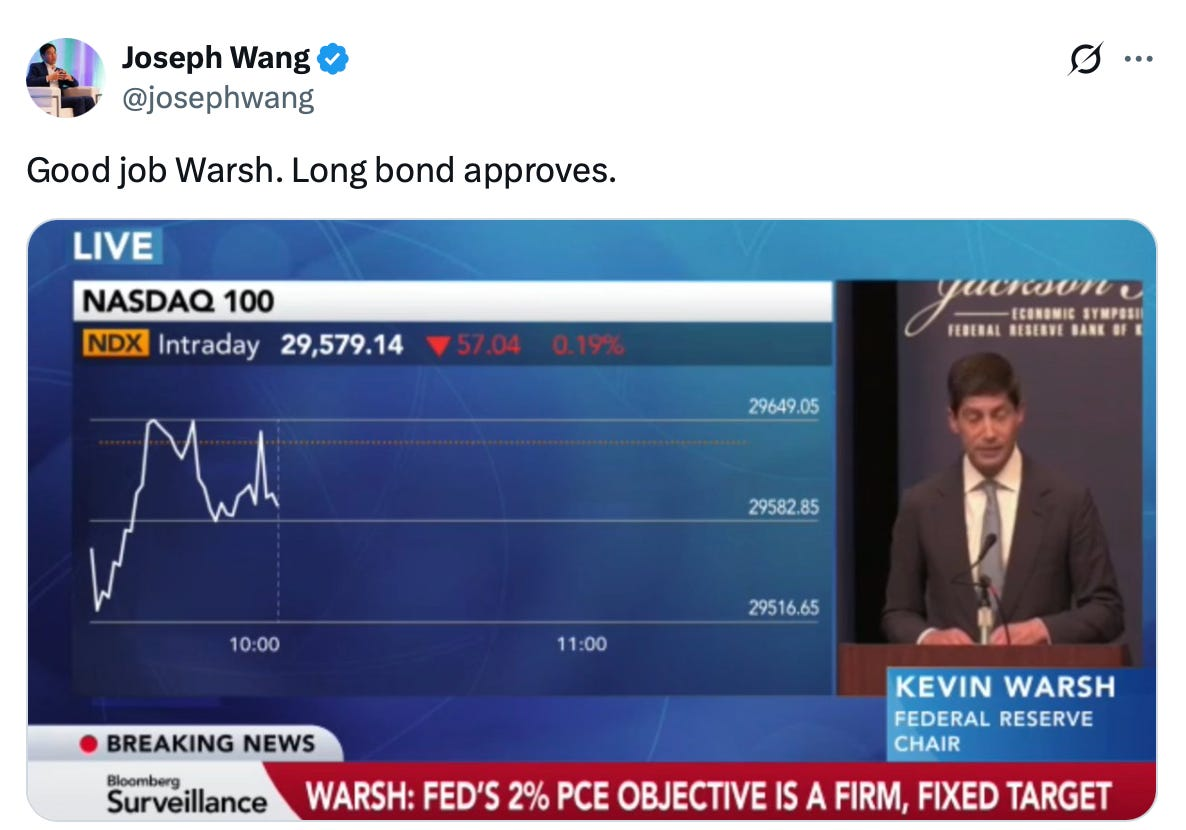
Treasuries saw significant volatility. As Joseph Wang noted above, long-dated bonds liked what they heard. Meanwhile, store-of-value assets—such as gold, silver, and even Bitcoin—took a heavy hit within minutes.
The question is: was this intentional? Did Warsh deliberately engineer this market reaction? If so, why? More importantly, why did a portion of the bond market reverse most of its gains before the day ended? And most critically, what does this mean for our own investments and portfolios?
All good questions, important questions, and I'll address each one for you.
What Warsh Actually Said
For someone who insists he no longer reveals anything to the media, Warsh seemed to say quite a lot on Friday.
Let's start with this gem: "...let there be no misunderstanding: the Federal Reserve's 2% price stability goal—measured by the Personal Consumption Expenditures (PCE) price index—is a firm, fixed target."
His mention of PCE came as no surprise, as it has long been the Fed's preferred inflation gauge and has remained persistently elevated for years. It currently stands at 3.7%.
The Chair made it clear once again that the Fed's target is 2%, and it isn't changing.
As he put it: "For 65 months of elevated inflation, the responsibility lies squarely with the central bank."
Doing the quick math, 65 months is roughly five and a half years. Warsh was essentially accepting responsibility on behalf of the Fed. He knows he wasn't in office during that period, he knows we know he wasn't there during those years, and he's here to clean up the mess for us. What a guy.
Forward guidance made another appearance in the prepared remarks: "Let me briefly outline what I've discussed this morning. You can call it an outline... you can call it a roadmap... just don't call it forward guidance."
He closed with a mission-driven tone: "What I stand here promising today is discipline, not a decision."
He also offered this observation: "Economic literature has long described its distorting effects: a hall of mirrors problem. If markets rely substantially on Fed guidance, and the Fed relies on market prices, then we are all more likely to be blindsided by new developments... more likely to be caught off guard when things turn... more likely to err in policymaking."
In other words, if markets focus on anticipating what the Fed will do, and the Fed worries about what markets expect, the two are feeding each other.
A nearly perfect circular reference. Meanwhile, nobody responds to the real economy itself. This renders almost all economic data virtually useless.
In any case, Warsh said he wants the Fed to be quieter while obtaining cleaner feedback information. His exact words: "The Fed needs clear market signals, as unfiltered as possible."
Somehow, while watching the speech and hearing him say over and over that 2% is the inflation target and it won't waver, a certain movie scene came to mind.
Some longtime readers may recall Paul Newman's "Cool Hand Luke." In one famous scene, the chain gang is working outdoors when the prison captain—Strother Martin—stands over Luke (Paul Newman) after beating him and says: "What we've got here is failure to communicate. Some men you just can't reach. So you get what we had here last week, which is the way he wants it. Well, he gets it. I don't like it any more than you men."
In other words, Luke's refusal to yield only invites harsher punishment, just like the beating they'd just witnessed. And Luke does break. There's a scene later in the film where he tells them he's seen the light, much to the dismay of everyone around him. But it doesn't last. He becomes Luke again.
Perhaps long-dated bonds are the Luke in this scenario. Maybe what Warsh was truly trying to convey is that the bond market refuses to acknowledge that the Fed has a new chair, one who is determined to control inflation. So, during Friday's speech, Warsh said "2%" four times and "inflation" thirty times.
And the market took a beating for it. The result?
Before the speech, fed funds futures priced roughly a 36% probability of a rate hike in September. By the close, that probability had risen to 57%.
What's more, looking out over the next two years, the expected number of rate hikes increased from 1.8 to approximately 2.4. That's roughly two-thirds of an additional rate hike—all priced in by a speech that never explicitly stated where rates are heading.
Remember, every rate hike—if it actually happens—directly lands on the cost of borrowing for you, me, and every company across the country.
Nowadays, whenever the Fed speaks, trading floors turn up the volume, hanging on nearly every word until the speech concludes. Then we spend the rest of the day drowning in a deluge of analysis and interpretation from economists and commentators.
Friday was an amplified version of that.
Highly respected Bloomberg economist Anna Wong summed it all up in a single sentence.
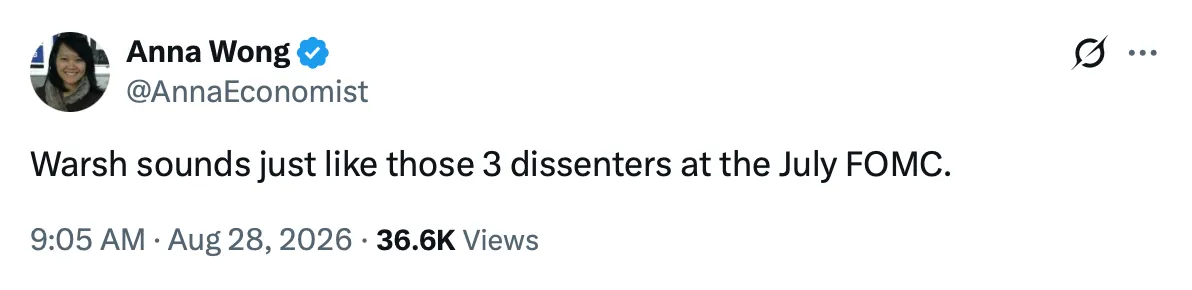
Remember, at the Fed's July meeting, the vote was 9 to 3 to hold rates steady, with three dissenting members wanting an immediate hike. So to her point—which I agree with—the Chair now appears to have aligned himself with those three.
For readers who have followed me for a long time, none of this comes as much of a surprise, since we already analyzed in depth back in July how Warsh wields his voice. Our conclusion then was essentially: He sings a hawkish tune publicly, possibly to protect his credibility, then refuses to commit to anything, leaving all his options open.
That's clearly the same playbook he used on Friday. Because despite never mentioning rate hikes at all, the market immediately began pricing them in.
Now the question is: will they actually hike in September?
Despite the market currently leaning toward "yes," I don't think so, because I believe what Warsh wants is operating room. He wants to maintain the status quo and avoid any substantive moves until he sees more data. At least, that's how I see it.
Interestingly, the federal deficit wasn't mentioned once, nor was the national debt, the Fed's balance sheet, or the long end of the curve. The word "Treasury" appeared only once in the entire speech, and merely as an example of a market they would be watching.
Of course, this isn't entirely surprising, especially given it was a one-way speech with no Q&A session with the press.
Still, given how elevated debt levels are, these are exactly the questions we'd have wanted someone to ask him.
This is an extremely important point, and we'll dive deeper into it shortly.
But first, let's talk about the market reaction and just how powerful Warsh's words were—at least temporarily.
Verbal Operation Twist
Let's start with some historical context. Don't worry, we'll keep it brief, but it helps to understand what happened on Friday.
We need to go back to 1961, when the Kennedy administration had a problem. They wanted short-term rates high because funds were flowing overseas seeking higher yields. Raising domestic short-term rates would help keep money at home, invested in American markets, rather than heading abroad. Additionally, they wanted long-term rates to stay low because that's what American businesses, consumers, and homebuyers actually borrow at, and the economy needed a boost.
They were eager to achieve this, so the Fed and the Treasury acted in concert.
They sold short-term government securities and used the proceeds to purchase long-term bonds. Remember, selling pushes bond prices down and yields up, while buying does the opposite. So at the front end of the curve, yields rose; at the back end, yields fell.
This operation was initially called "Operation Nudge" because the plan was to nudge long-end rates down while keeping short-end rates up. Someone clever later pointed out that the yield curve itself was rotating around its midpoint, comparing it to a hugely popular song of the time, Chubby Checker's "The Twist."
And so, the Fed/Treasury operation has been known as "Operation Twist" ever since.
So, did Operation Twist work? Sort of—long-end rates fell by about 15 basis points, or 0.15%. Not nothing, but hardly a game-changer.
Fast forward to the post-financial-crisis era, and the Fed implemented it again on its own in 2011—"Operation Twist, Season 2." That time they got about 0.25 percentage points of effect. Again, not nothing, but an enormous cost for such a modest move.
In any case, that's the play. Push one end of the curve up, push the other down, without touching the overnight rate at all.
Now you might ask, why would they want to do this today?
Simply put, high short-term rates make the Fed look serious about inflation. Low long-term rates reduce the cost of mortgages, auto loans, and corporate borrowing.
The problem is, if bond buyers recognize that you're executing Operation Twist, they instinctively know it ultimately leads to more money printing and eventually more inflation.
So, I believe the question both Warsh and Bessent are asking themselves—and each other—is: how can you execute Operation Twist without it being so obvious?
Here's how.
Nine days before Warsh took the stage in Wyoming, Scott Bessent doubled the Treasury's long-duration bond buyback program, then went on CNBC and called it "Treasury Twist."
Note: not "Operation Twist," because that would imply Fed involvement, which would imply more money printing. To be clear, this operation does cost money. Real money, going into the open market to buy actual bonds.
And on the Fed side? As we said, the Fed wasn't involved in Treasury Twist.
Then on Friday, Warsh bought no bonds. He sold no bonds. He didn't move the overnight rate a single basis point. He couldn't do that for at least another two and a half weeks.
At least not without an emergency intermeeting move—and that would look like panic. No newly installed Fed chair would want to convey that signal.
So how do you convey seriousness about inflation without any policy action? With words. He just talked, and talked, and talked.
- "2%." Four times.
- "Target." Twice.
- "Inflation." Thirty times.
And the market reacted. Hook, line, and sinker.
During the speech, the ultra-short end—bills maturing before the next Fed meeting—barely moved, but look at how the rest of the curve performed.
First, the short end.
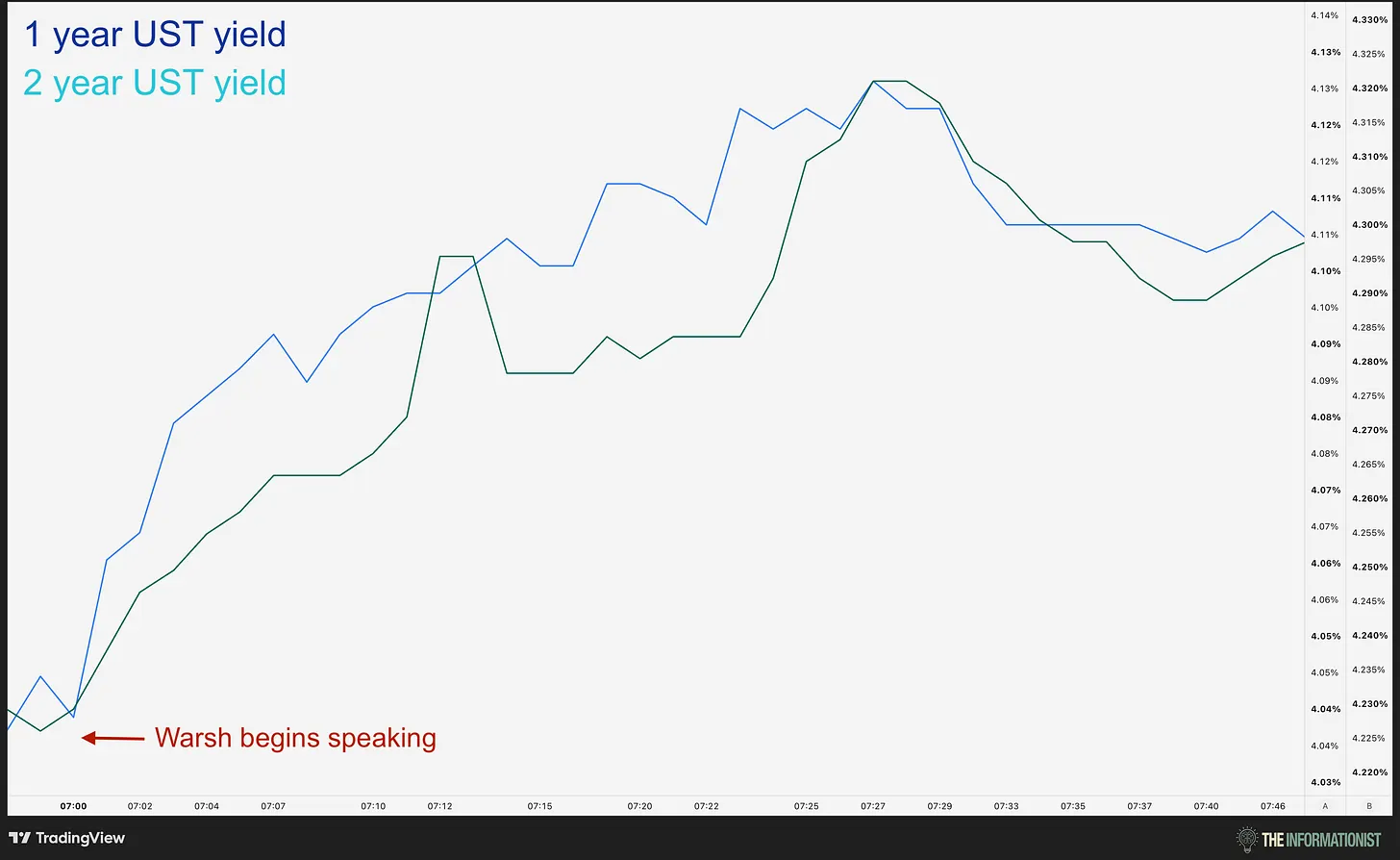
With each utterance of the word "inflation," the 1-year yield ticked higher, rising from 4.04% to a peak of 4.13% by the speech's conclusion. That's roughly one-third of a single Fed rate hike (25 basis points).
The 2-year rose 10 basis points. That's approximately 40% of a full Fed rate hike.
Meanwhile, the 30-year Treasury yield fell from 5.21% before the speech to 5.16% as it concluded. The 20-year behaved nearly identically.
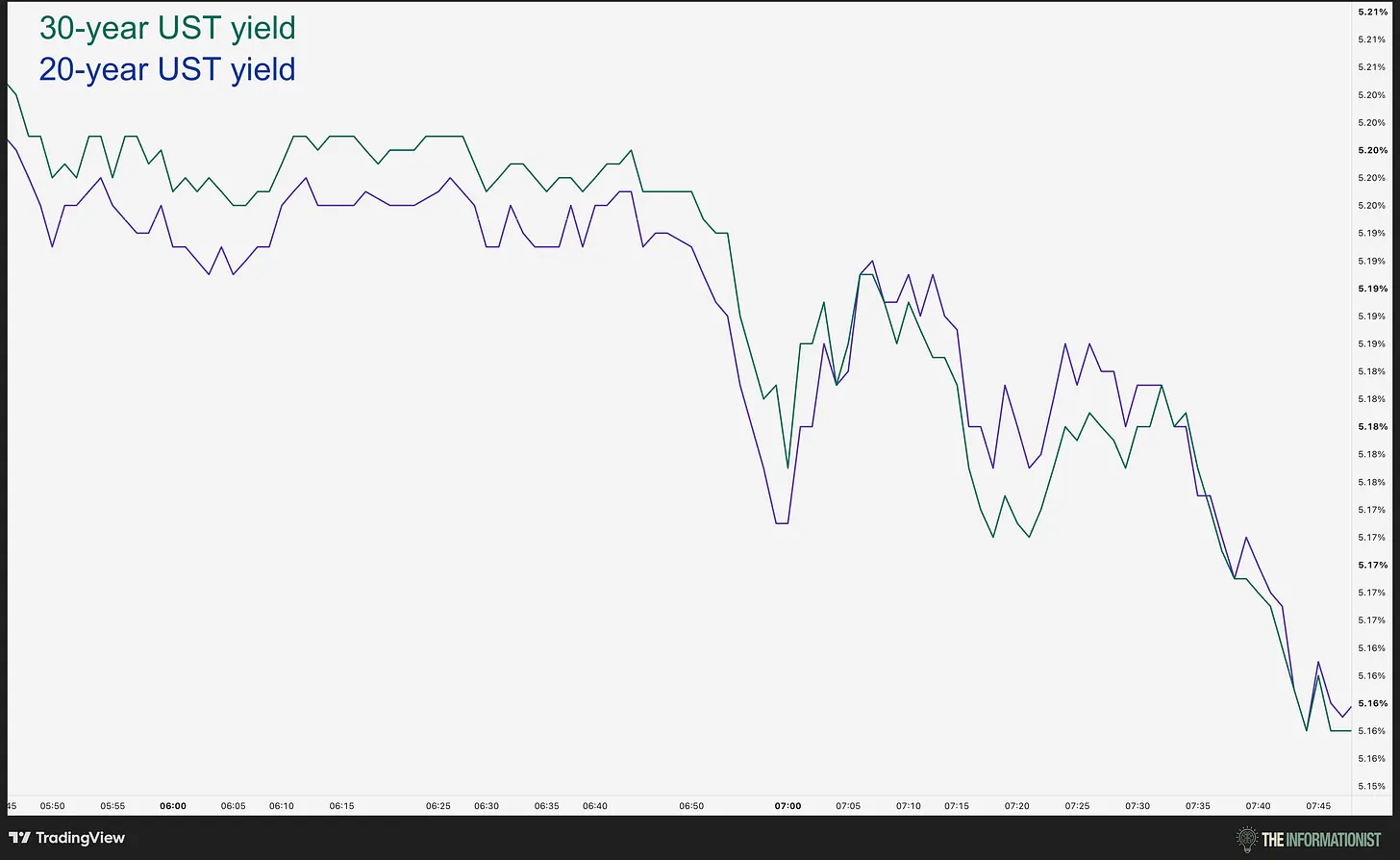
In other words, during the Chair's remarks, the market responded with short-end yields rising and long-end yields falling.
I've been in this business for many years, and this is one of the clearest real-time market repricings I can recall. But not a single dollar was spent—just words. Especially the heavy repetition of one particular word. So we have no choice but to call it a "verbal Operation Twist."
For a few hours that morning, it worked exactly as Warsh intended. But of course, the bond market—as it always eventually does—regained its senses.
The Part He Can't Control
So what exactly did all that talk buy Warsh? To answer that, we need to look at three different directions, each telling us something different.
Let's start with the twist itself. You could actually see it happening in real time as he spoke. The question is whether it lasted. Here's the spread between the 30-year and the 2-year for the day.
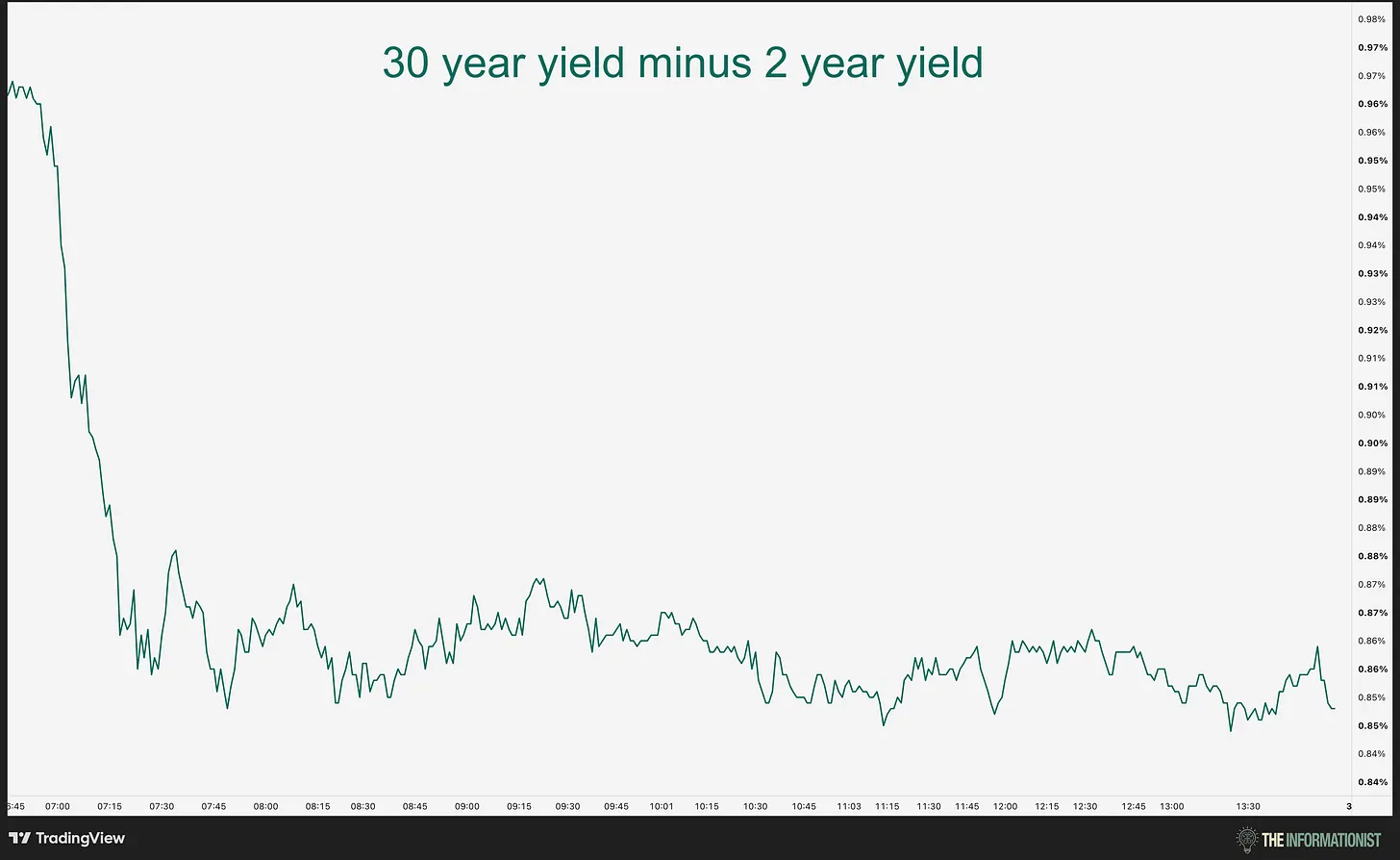
As you can see, within 20 minutes of the speech starting, it dropped sharply, narrowing from about 0.96 before the speech to roughly 0
This content is for informational and educational purposes only and does not constitute investment advice related to BTCC. BTCC makes every effort but cannot guarantee the truthfulness, accuracy, or originality of the content above.