The Unpriced Risk in Crypto: Why Trillions in Institutional Capital Remain on the Sidelines

Billions are flowing into crypto ETFs, yet the real institutional money—the pension funds, sovereign wealth funds, and multi-trillion-dollar asset managers—is still watching from the bleachers. The reason isn't volatility or headlines; it's a fundamental gap in how risk is measured and priced.
The Black Box Problem
Traditional finance runs on models. Value-at-risk, stress tests, correlation matrices—these are the tools that let a pension fund trustee sleep at night. Crypto throws a wrench into that machinery. How do you model the risk of a decentralized network fork? Price the contagion effect from a smart contract exploit on a protocol you've never heard of? You can't. It's unpriced, unquantified, and that makes it uninvestable for the big leagues.
Beyond Compliance: The Real Hurdle
Regulation is coming, but it solves the paperwork problem, not the risk problem. A regulated exchange doesn't magically model the tail risk of a validator set collapse. It just means the paperwork for losing money is in perfect order—a classic finance move, prioritizing process over substance.
The Infrastructure Gap
The market lacks the deep, institutional-grade risk analytics that Wall Street takes for granted. Where are the crypto-native equivalents of Moody's for DeFi protocols, or the decades of default data for crypto lending? They're being built in real-time, with real money. For now, that translates into a massive risk premium that keeps capital cautious.
This isn't a bear case; it's the final frontier. The moment this 'unpriced' risk gets a price tag is the moment the floodgates truly open. Until then, the sidelines are looking pretty crowded—and pretty smart.
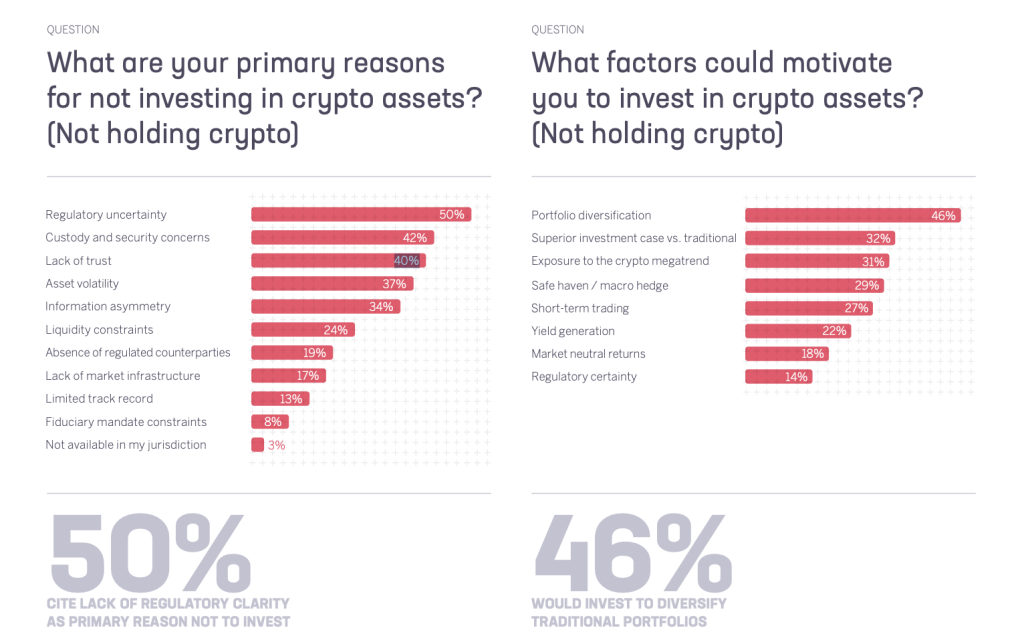
This hesitation has a price. While the fintech market globally attracted $44.7 billion during H1’25, global VC investment in blockchain startups for H1 2025 was roughly five times lower, at approximately $ 8 billion. Furthermore, a recent survey found that 9 out of 10 institutional investors cite “counterparty risk” as their major concern.
Look at PayPal’s MOVE into crypto. They didn’t partner with a cutting-edge DeFi protocol. They went with Paxos, a regulated, predictable partner since 2012. Paxos isn’t the most innovative. But it’s safe. It’s understood.
Now imagine if PayPal had partnered with a leading decentralized exchange or a community-driven DAO. The user experience WOULD be radically different, more than just digital dollar transfers. But that didn’t happen. Not because the tech wasn’t ready, but because the risk wasn’t.
Wall Street Limits Exposure to Crypto Because We Speak Different Risk Languages
The Web2 governments and institutions still see crypto as unstable, unsustainable, and volatile. The idea of “too big to fail” doesn’t apply here. Mt. Gox & FTX, Terra Luna, Anchor Protocol: each has faced major incidents while having all the reasons to be trusted within the DeFi community. That proves that even the largest players can be hacked, mismanaged, or collapse in days, casting a long shadow on the whole ecosystem.
Over half of the projects launched since 2021 are already gone for good. Institutions can’t afford to invest in this graveyard. Until a private U.S. pension fund can see that Project X has a 3% probability of loss and Project Y has a 5% but offers a higher premium, they have nothing to underwrite.

Therefore, governments and institutions can’t confidently partner with projects they aren’t sure will still exist in a year. Why? Because there’s no common language for risk.
The crypto insurance market, a key indicator of institutional comfort, remains nascent, with total coverage capacity covering only around 9% of the total assets locked in DeFi.
Still in the Gray Despite National Reserves and ETFs
Even the recent wave of Bitcoin ETFs doesn’t prove broad institutional trust. ETFs are the safest possible entry; they let investors gain exposure to blue chips without touching the underlying technology. It’s crypto, sanitized. Removed from the operational risk, the smart contract risk, and the team risk. On the one hand, this is a multi-billion-dollar on-ramp; on the other hand, ETFs beat the entire innovation crypto offers: decentralization and anonymity.
The crypto space is still a gray zone, a digital Wild West. And while that’s been an opportunity for some to earn, it’s also been a reason for many to stay away. The original Wild West didn’t end by accident. It ended with the arrival of law, order, and standards.
Unfortunately, the regulatory landscape only confirms the crisis of standards. Jurisdictions are rushing to contain the chaos, but their divergent approaches are creating global fragmentation, not global confidence.
Singapore regulates to capture economic value, while China and India restrict access to maintain financial control and stability. The EU builds comprehensive frameworks to attract business, while the US abruptly reversed its enforcement posture in 2025 to support industry growth. Every nation is acting in its own interests, leaving the blockchain industry without a common foundation for trust.
This confusion creates a contrary incentive for builders & for institutions: the sheer complexity of compliance is now a primary reason to avoid it both for investors and developers. As a result, there is a rise of projects designed to be stateless and fully decentralized from day one, opting out of the institutional exposure entirely because engaging with it is untenable.
The world’s regulators aren’t waiting for us to figure out how to measure risks in Web3. Some are building walls. Others are drafting rulebooks. All of them are creating standards by default.
This is our last chance for self-regulation. Either we build a credible framework ourselves, one that works across borders and protocols, or we’ll have one imposed on us. And history shows that when solutions come from the outside, they rarely fit.
Self-Regulation Can Break the Ceiling
There is a way to keep both innovation and safety without sacrificing institutional exposure: credible self-regulation.
Crypto doesn’t need to wait for rules to be imposed from the outside. It can start from within, but this requires more than good intentions. It demands a mature, reputable player to cut through the noise; an entity that can translate the industry’s complexities into a fair and efficient framework that regulators and builders can both trust.
But without that shift, growth will stall. Crypto has the potential to redefine how we bank, invest, and exchange value. But potential isn’t enough. Without responsibility, without safety, without trust, it won’t reach the next wave of users.
And that’s a ceiling the whole industry is about to hit.
Disclaimer: The views and opinions expressed in this article are those of the author and do not necessarily reflect the views of Cryptonews.com. This article is for informational purposes only and should not be construed as investment or financial advice.
