Bitcoin’s Latest Plunge: Not Just Another Correction, But a Clear Capitulation Event – Here’s Why

Bitcoin just sliced through another support level. This isn't your average dip—it's the sound of weak hands finally breaking.
The Capitulation Signal Everyone Missed
Forget the usual volatility noise. This move carries the distinct, metallic taste of panic selling. On-chain metrics are flashing red, not with the gentle warning of a pullback, but with the harsh glare of a full-blown surrender. Long-term holders are watching, not selling, while leveraged positions get liquidated in a cascade that feels more like a fire sale than a strategic retreat.
Why This Time Is Different
Market structure tells the real story. The volume profile shows exhaustion, not profit-taking. It's the kind of washout that historically scrubs the market clean of over-optimism and over-leverage, setting a sturdier floor for the next leg up. Think of it as the market's brutal, yet efficient, way of resetting expectations—usually while Wall Street pundits, who still don't get it, are busy explaining why it's a 'bubble'.
So, while the headlines scream crisis, the smart money sees opportunity. Capitulation doesn't mark an end; it lays the foundation. The real move begins when the last doubter throws in the towel.
True Capitulation, Not A Routine Bitcoin Pullback
The market was rocked by a recent decline in the price of Bitcoin, but this pullback comes with an extra layer. Alphractal, an advanced investment and on-chain data analytics platform, has shed crucial insights about the decline using several key indicators to determine the unseen trend.
After carrying out its research, the on-chain platform revealed that the latest Bitcoin drop was not just another correction, but a clear instance of a capitulation event. This abrupt turnaround seems to have embodied all the characteristics of a full-scale capitulation event. These include an emotional flush-out when panic selling, forced liquidations, and intense dread came together in one dramatic moment.
Alphractal’s reading is backed by three major signals that rarely show up together, suggesting a pivotal moment for BTC. Such a trend may be the turning point that reshapes the short-term trajectory of the crypto king.
The first signal highlighted by the platform comes from the bitcoin Hash Rate, which has witnessed a steady decline over the last 30 days. Presently, miners are turning off their machines, triggering heightened pressure on the ecosystem. When miners begin to lose money, it typically implies that the market might have reached its peak.
Another signal is coming from the BTC price drawdown. After a fast, violent drop, the metric is hitting extreme levels beyond the historical median. This is not just a technical drop, but it’s pain, triggered by forced selling and liquidation.
A Rare Trend And A Good Entry Opportunity
Finally, the last signal is the recent spike in active supply as those holding BTC for months or years have begun spending their coins. A behavior of this kind only unfolds when investors exhibit heightened caution, causing sentiment to drop.
An interesting aspect about this trend is that when these 3 signals flash in unison, the Capitulation Oscillator tends to rise. This is a moment that nearly always denotes the conclusion of a downward trend or a leveling phase, as was the case in 2021.
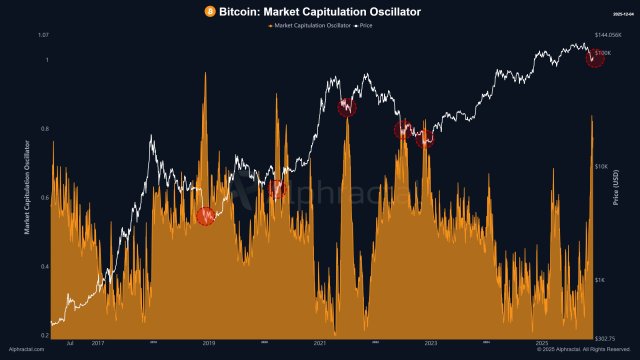
While it has played out in previous scenarios, it is not a guarantee of an immediate bottom. However, moments like these have historically been uncommon and frequently present opportunities that only occur once or twice every cycle, especially for those rooted in on-chain data.
Joao Wedson, the founder of Alphractal, also confirms these signals, which point to real capitulation. According to Wedson, the recent correction was the most severe capitulation event since 2022.
Nonetheless, this has traditionally led to the formation of long accumulation regions before the price makes its next macro direction. In other words, Wedson noted that the highest probability scenario is that 2025 will end in a broad sideways range; a classic phase of accumulation or redistribution.
