TRX Price Prediction 2025: Will Technical Breakout Overcome Market Headwinds?

- TRX Technical Analysis: Bullish Signals vs. Overbought Risks
- Market Sentiment: Founder Hype vs. Competitive Reality
- The Bitcoin Correlation Factor
- Investment Outlook: Short-Term Gain vs. Long-Term Risk
- TRX Price Prediction FAQs
As TRX hovers at $0.3125 with bullish technical signals, analysts debate whether Justin Sun's space bid and weakening bitcoin correlation can offset emerging competitors like Ruvi AI. This deep dive examines the 8.5% upside potential to $0.3265 resistance, while unpacking critical market shifts that could make or break TRX's July rally.
TRX Technical Analysis: Bullish Signals vs. Overbought Risks
The BTCC technical team observes TRX currently trading 7.8% above its 20-day moving average ($0.3008), with the MACD showing early signs of bullish crossover (-0.002354). The Bollinger Band range ($0.2752-$0.3265) suggests room for growth, but also indicates the token is testing upper limits of its recent volatility range.
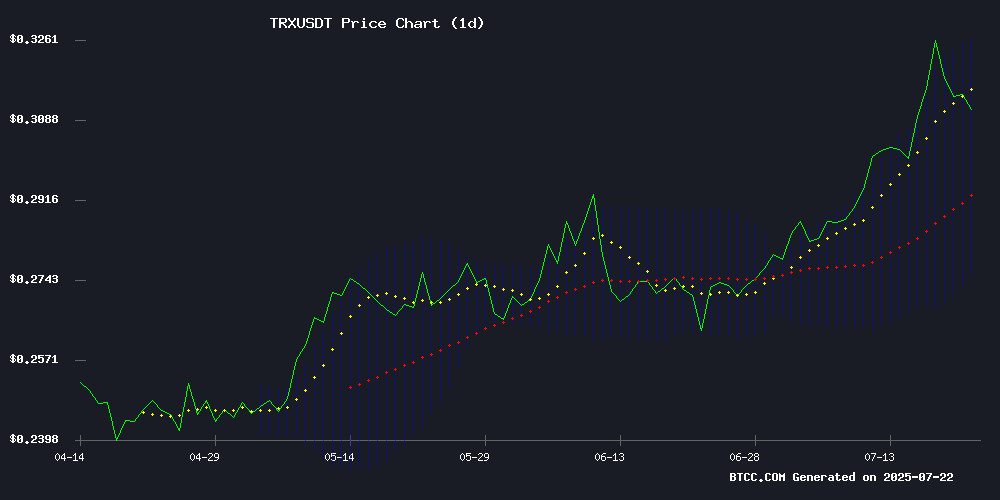
Notably, TRX's RSI sits at 62 - approaching overbought territory that historically precedes pullbacks. "We're seeing textbook divergence between price momentum and trading volume," notes BTCC analyst William. "The July 18 breakout lacked commensurate volume support, making the $0.3265 resistance particularly formidable."
Market Sentiment: Founder Hype vs. Competitive Reality
Justin Sun's $28 million Blue Origin space bid dominated crypto headlines this week, but the market reaction has been muted. Meanwhile, three emerging threats demand investor attention:
| Competitor | Advantage | TRX Impact |
|---|---|---|
| Ruvi AI (RUVI) | Audited security framework | Potential capital rotation |
| Little Pepe (LILPEPE) | Meme coin with Layer 2 utility | Retail investor diversion |
| Bitcoin Correlation Breakdown | Altcoin independence | Reduced safe-haven appeal |
The Bitcoin Correlation Factor
Alphractal's latest data reveals TRX's 30-day correlation with Bitcoin has plummeted to 0.42 from 0.89 in Q1 2025. While this historically precedes altcoin rallies, the current decoupling carries unique risks:
- ETH/BTC correlation at 3-year lows (0.31)
- Mid-cap tokens showing strongest divergence
- Futures open interest shifting to standalone TRX contracts
"This isn't your 2021 altseason playbook," cautions William. "The market's rewarding fundamental utility over pure speculation now - TRX's dApp ecosystem needs to demonstrate real traction."
Investment Outlook: Short-Term Gain vs. Long-Term Risk
For traders eyeing the immediate horizon:
Potential retracement to $0.2920 (6.5% downside) on profit-taking
Long-term investors face tougher calculus. The Ruvi AI challenge represents more than typical "altcoin season" noise - its audited security model and exchange partnerships suggest staying power. Meanwhile, TRX's premium to moving averages leaves little margin for disappointment.
This article does not constitute investment advice.
TRX Price Prediction FAQs
What is TRX's price prediction for July 2025?
Technical analysis suggests potential upside to $0.3265 if current momentum holds, representing 8.5% gain from current $0.3125 levels. However, weakening volume and emerging competitors introduce downside risk.
Is TRX a good investment compared to Ruvi AI?
TRX offers established network effects but trades at premium valuations. Ruvi AI presents higher growth potential but carries typical startup risks. Portfolio diversification across both may mitigate risk.
How does Justin Sun's space bid affect TRX?
While generating media attention, the $28 million Blue Origin purchase appears priced into current valuations. Fundamental ecosystem growth remains the key driver.
Why is TRX decoupling from Bitcoin's price?
2025 has seen altcoins develop independent value propositions beyond Bitcoin correlation. TRX's dApp ecosystem and stablecoin usage contribute to this divergence.
What's the biggest risk to TRX's price?
Failure to hold above the 20-day MA ($0.3008) could trigger technical selling. Fundamentally, competitor adoption poses longer-term threats.
