Crypto’s $12M Political Power Play Shakes UK Government as Reform Party Donation Sparks Ban Debate

Crypto just dropped a political bomb in Westminster—and the establishment is scrambling to respond.
The Digital Donation That Changed Everything
A single cryptocurrency transfer worth $12 million landed in Reform UK's coffers, instantly becoming the largest political donation in recent British history. This isn't just money changing hands—it's a blockchain-powered statement that bypasses traditional banking channels and lands directly in the political arena.
Westminster's Regulatory Panic Button
Whitehall corridors are buzzing with emergency meetings as ministers confront an uncomfortable reality: digital assets can fund political movements faster than parliamentary committees can schedule hearings. The proposed ban isn't about security—it's about control. Traditional finance gatekeepers watched $12 million slip through their oversight, and they're not happy about it.
The Transparency Paradox
Here's the delicious irony: every satoshi of that donation is permanently recorded on a public ledger, visible to anyone with an internet connection. Meanwhile, offshore bank accounts and opaque corporate donations continue flowing through London's financial district with a wink and a nod. The establishment fears transparent money more than hidden money—which tells you everything about their priorities.
Digital Democracy's Arrival
This $12 million transaction proves crypto isn't just speculation—it's political infrastructure. Reform UK now operates with campaign funding that clears instantly, crosses borders without permission, and can't be frozen by nervous bankers. Traditional parties relying on slow wire transfers and donor dinners suddenly look like analog relics.
The Real Target Isn't Crime—It's Competition
Watch how quickly 'consumer protection' rhetoric appears when new money challenges old power. The same regulators who missed multiple banking collapses now position themselves as crypto experts. A cynic might note they're protecting their relevance—and their friends in traditional finance—more than the public.
That $12 million donation didn't just fund a political party—it exposed a system terrified of transparent, borderless value transfer. The ban debate isn't about stopping crypto. It's about stopping what crypto enables: political movements that don't ask permission.
Harborne’s £9M donation Reshapes UK as Crypto Money Enters UK Politics
Harborne’s donation comes at a time when, as the next general election is not due until 2029, but local elections are scheduled for May. It also comes as Reform UK has remained at the top of several national opinion polls since the spring.
Harborne’s £9 million donation breaks the previous record of £8 million, which was set in 2019 by supermarket heir Lord David Sainsbury in support of the Liberal Democrats.
Separately, Lord John Sainsbury left £10 million to the Conservatives through his will in 2022.
Figures released by the UK Electoral Commission show that Reform UK raised more than £10.2 million between July and September, over twice the amount collected by the Conservatives in the same period, which brought in £4.6 million.
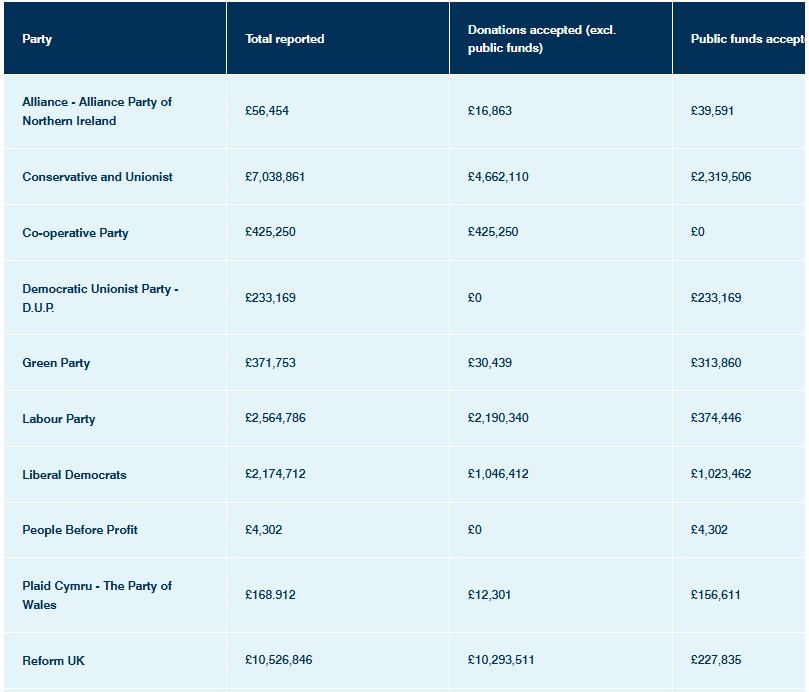
Labour brought in £2.1 million, and the Liberal Democrats reported £1 million. This makes it the first full quarter in which Reform will outpace Conservatives in fundraising since the general election in 2024.
Still, the longer-term numbers slightly favor the Conservatives, showing that since July 2024, they have raised around £14.4 million in total, compared with Reform’s £13.5 million.
Conservative leader Kemi Badenoch downplayed the impact of Harborne’s contribution, describing it as a “one-off” and insisting her party remains stronger when it comes to steady, repeat donors
Beyond fundraising, the donation has reignited debate around the role of cryptocurrency in UK politics.
In May, Reform leader Nigel Farage announced that the party would begin accepting Bitcoin donations, making it the first UK political party to do so.
The party later launched a dedicated digital donation portal and confirmed that it had already received a small number of crypto contributions, the first recorded instance of such donations in British political history.
Foreign Influence Fears Drive UK Review of Crypto Political Funding
That decision is now under increasing political scrutiny. The UK government says it’s now looking into whether cryptocurrency donations should be blocked entirely for political parties.
While no formal proposal has been confirmed, officials say discussions are underway across Whitehall about it, driven by rising concerns over transparency and the risk of foreign interference in British politics.
 UK considers crypto political donation ban, threatening @Nifel_Farage Reform UK’s campaign and fundraising amid foreign interference and money-laundering concerns.#UKPolitics #ReformUK https://t.co/WBR07U05bb
Additionally, security specialists caution that while blockchain records are public, the real origin of funds can still be obscured through layered wallets, intermediaries, and offshore structures.
The debate gained urgency after former Reform Wales leader Nathan Gill was convicted and sentenced to over 10 years in prison for accepting payments to push pro-Russian narratives while serving as a Member of the European Parliament.
The Ministry of Housing, Communities and Local Government, which is leading work on the Elections Bill, has also warned that existing rules leave the political system exposed to covert foreign influence.
Proposed changes are expected to focus on donations funneled through shell companies and to introduce stricter risk checks for politically sensitive contributions.
The discussion unfolds as the UK moves ahead with its wider digital asset rules. On December 3, Parliament passed a law recognizing cryptocurrencies and stablecoins as legal property for the first time under UK law.
