Trump's Dilemma? US Treasury Yields Near 5%: Impact on Stocks, Gold, and Digital Assets

The real protagonist of this market volatility is not a single stock or sector, but the US Treasury yield, which is once again approaching a critical level.
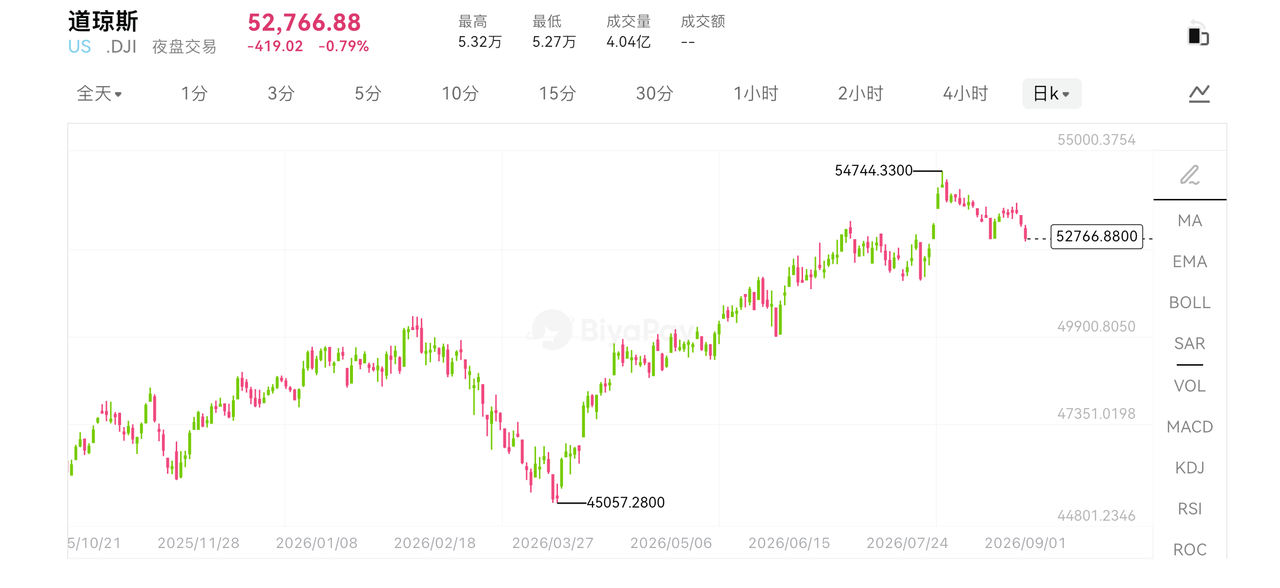
On September 1, 2026, BiyaPay market data showed that the three major US stock indices extended their decline. The Dow fell 0.8%, the S&P 500 fell 0.7%, and the Nasdaq fell 1%, marking the third straight day of losses for the major indices. Meanwhile, the 10-year Treasury yield rose to about 4.79%, and the 30-year Treasury yield approached 5.3%. Rising oil prices, inflation worries, the approaching Fed meeting in September, and US fiscal strains have combined to prompt a market reassessment.
Why Are Treasury Yields So Important?
Because they are one of the most core benchmarks in global asset pricing. When interest rates rise, stocks, gold, and digital assets are all pulled into the same comparison. Stocks depend on whether valuations can hold up, gold depends on real interest rates and the dollar, and digital assets like Bitcoin and Ethereum depend more on liquidity and risk appetite.
That's why the approach of Treasury yields to 5% cannot be seen as just a bond market fluctuation.
When Treasury yields move, stocks get nervous—this is not a new story. But this time, the pressure comes not only from the Fed, but also from oil prices, fiscal deficits, the Trump administration's policy pace, and financing needs from AI capital spending. The market's real concern is not a single day's move, but that the high interest rate environment may last longer than expected.
As the linkages between these assets strengthen, looking at just one market can cause you to miss signals. For example, in the BiyaPay App, you can simultaneously track the price movements of US stocks, Hong Kong stocks, BTC, ETH, and other assets. BiyaPay, as a global one-stop asset allocation platform, covers digital assets, US stocks, Hong Kong stocks, and fiat currency exchange, making it more suitable for observing price changes and risk appetite shifts across different markets.
For this kind of high-volatility market, what really matters is not fixating on a single price point, but seeing who reacts first and who follows among Treasury bonds, the dollar, tech stocks, gold, and digital assets. That way, when you look back at the fluctuations in stocks, gold, or digital assets, the logic becomes much clearer.
As Treasury Yields Near 5%, the Market Worries About More Than Just Rates
The 10-year Treasury yield near 4.8% and the 30-year near 5.3% together reflect not just short-term rate hike expectations, but a repricing of long-term funding costs.
Short-term rates are more tied to Fed policy, while long-term rates are more complex. They reflect inflation, fiscal deficits, Treasury supply, economic growth expectations, and whether long-term investors are willing to absorb the debt. US debt has surpassed $40 trillion, and interest payment pressure is mounting. The Treasury needs to keep issuing bonds, so the market naturally demands higher yields to compensate for risk.
This is Trump's dilemma. Politically, he wants a strong economy, stable stock market, and low financing costs; but the bond market doesn't just listen to slogans—it looks at inflation data, fiscal trajectory, and long-term creditworthiness. If oil prices continue to rise, inflation pressure will return; if the fiscal deficit doesn't ease, long-term bond supply pressure won't disappear. As long as these factors persist, Treasury yields won't be easily pushed down.
So the core of this market is not simply "will the Fed hike or not," but that investors are questioning whether the high interest rate environment will last longer than previously thought.
For US Stocks, Pressure Falls First on Valuations
Rising Treasury yields have the most direct impact on US stocks through valuation pressure. Especially for tech stocks, AI stocks, and high-growth sectors, stock prices often embed high future growth expectations. When the risk-free rate rises, the attractiveness of discounted future cash flows decreases, and the market's tolerance for high-valuation assets also declines.
That's why the Nasdaq has been weaker in this pullback. The AI theme hasn't been disproven—cloud computing, chips, data centers, and energy infrastructure remain areas of market focus. But the problem is that the AI supply chain has risen too fast, and many companies' stock prices have already priced in several years of growth expectations. Now that Treasury yields are rising, the market naturally asks whether orders can continue to be fulfilled, whether gross margins can hold, and whether capital spending will drag on cash flow.
Simply put, in a low interest rate environment, the market is more willing to pay for long-term stories; in a high interest rate environment, the market cares more about profits, cash flow, and certainty.
This is the key for US stocks going forward. It's not that good earnings guarantee a rise, or poor earnings cause a fall, but whether the quality of growth can offset the valuation pressure from rising rates.
Gold Is Not Just a Simple Safe-Haven Trade
The impact of rising Treasury yields on gold is more subtle.
Gold itself pays no interest. When Treasury yields rise and the dollar strengthens, the opportunity cost of holding gold increases, and gold prices typically come under pressure. Recently, gold has pulled back from highs, and this logic is behind it. Public market data shows that on September 1, gold futures briefly fell below $4,400, a significant correction from the late August high.
But gold is not purely an interest rate asset. As long as the market worries about fiscal deficits, geopolitical risks, inflation resurgence, and monetary credibility, gold will still have safe-haven and hedging demand. So gold is currently facing two forces: high yields and a strong dollar suppressing prices on one side, and fiscal and geopolitical risks providing support on the other.
This means that in the short term, gold should not be viewed solely through the lens of "safe haven." What really matters is the real interest rate. If nominal rates rise faster than inflation expectations, gold tends to be pressured; if inflation and fiscal concerns continue to heat up, gold may regain investor attention.
Digital Assets Depend on Liquidity and Risk Appetite
Digital assets like Bitcoin and Ethereum are also sensitive to Treasury yields. The reason is simple: in short-term trading of digital assets, liquidity and risk appetite carry significant weight.
When Treasury yields rise and the dollar strengthens, market funds tend to return to assets with more certain returns, and risk assets come under pressure. Reports show that on September 1, Bitcoin briefly fell to around $77,900 in pre-market trading, affected by rising rates along with US tech stocks. This shows that under strong macro pressure, digital assets do not completely decouple from global liquidity conditions.
But digital assets have another side. Whenever the market discusses US fiscal deficits, monetary credibility, and long-term debt pressures, Bitcoin is sometimes placed in the framework of a "macro hedge asset." That is, it is suppressed by high rates in the short term, but repriced by fiscal and monetary issues in the medium to long term.
This is the most complex aspect of digital assets right now. They are neither purely risk assets nor stable safe-haven assets, but switch narratives depending on the market environment. When rates rise, they follow risk assets lower; when fiscal credibility is discussed, they may regain attention.
Before the September Meeting, the Market Will Keep Watching Data
The next FOMC meeting will be held on September 15-16. In his Jackson Hole speech, Warsh emphasized that the 2% PCE inflation target is fixed, and short-term rates remain the primary tool for achieving the dual mandate. He also mentioned that 12-month PCE inflation is 3.7%, and the 6-month change is 4.1%, with inflation still above target.
The impact of this statement on the market is direct. The Fed did not provide a clear path, but told the market one thing: as long as inflation does not return to target quickly enough, policy cannot easily shift to easing.
Going forward, nonfarm payrolls, CPI, PCE, oil prices, and Treasury auction results will all affect market expectations. If data remains strong or inflation pressure does not cool significantly, Treasury yields may stay elevated, and valuation pressure on US stocks will persist. If economic data weakens markedly, the market will shift from worrying about inflation to worrying about growth.
This is what makes the current market difficult to judge. Inflation is not fully resolved, growth cannot slow sharply, and both the Fed and the market are waiting for more evidence.
The Real Variable Is the Rise in Funding Costs
So, after Treasury yields approach 5%, the impact on US stocks, gold, and digital assets is certain to exist, but the directions are not entirely the same.
US stocks fear valuation re-discounting, especially AI and tech growth stocks. Gold is pressured in the short term by high rates and a strong dollar, but fiscal, geopolitical, and inflation risks provide support. Digital assets are caught between liquidity pressure and the macro hedge narrative, and short-term volatility will be greater.
Whether Trump can stabilize market sentiment ultimately depends on whether the bond market buys in. As long as long-term Treasury yields remain high, global assets will repeatedly undergo repricing. Stocks depend on whether earnings can offset rate pressure, gold depends on real rates and safe-haven demand, and digital assets depend on liquidity and risk appetite.
What this market really reminds us is that the trading environment of focusing only on growth stories is changing. After funding costs rise again, every asset class must answer the same question: can the expectations embedded in prices withstand the test of high interest rates?
This content is for informational and educational purposes only and does not constitute investment advice related to BTCC. BTCC makes every effort but cannot guarantee the truthfulness, accuracy, or originality of the content above.