Bitcoin enfrenta su mayor caída en dificultad de minería desde 2021: ¿Oportunidad o advertencia?

El hashrate de Bitcoin se desploma, marcando el ajuste más severo en la dificultad de minería en cuatro años.
Los mineros enfrentan tormenta perfecta: costos energéticos récord y recompensas a la baja. ¿Estrategia o desesperación?
Mientras Wall Street sigue obsesionada con los ETFs, la red muestra su mecanismo de autodefensa más brutal desde el último ciclo bajista.
Bonus: Los tradicionalistas financieros siguen esperando el 'momento Kodak' de las cripto... mientras Bitcoin simplemente se reajusta y continúa.
Profitability metrics spell mining stress
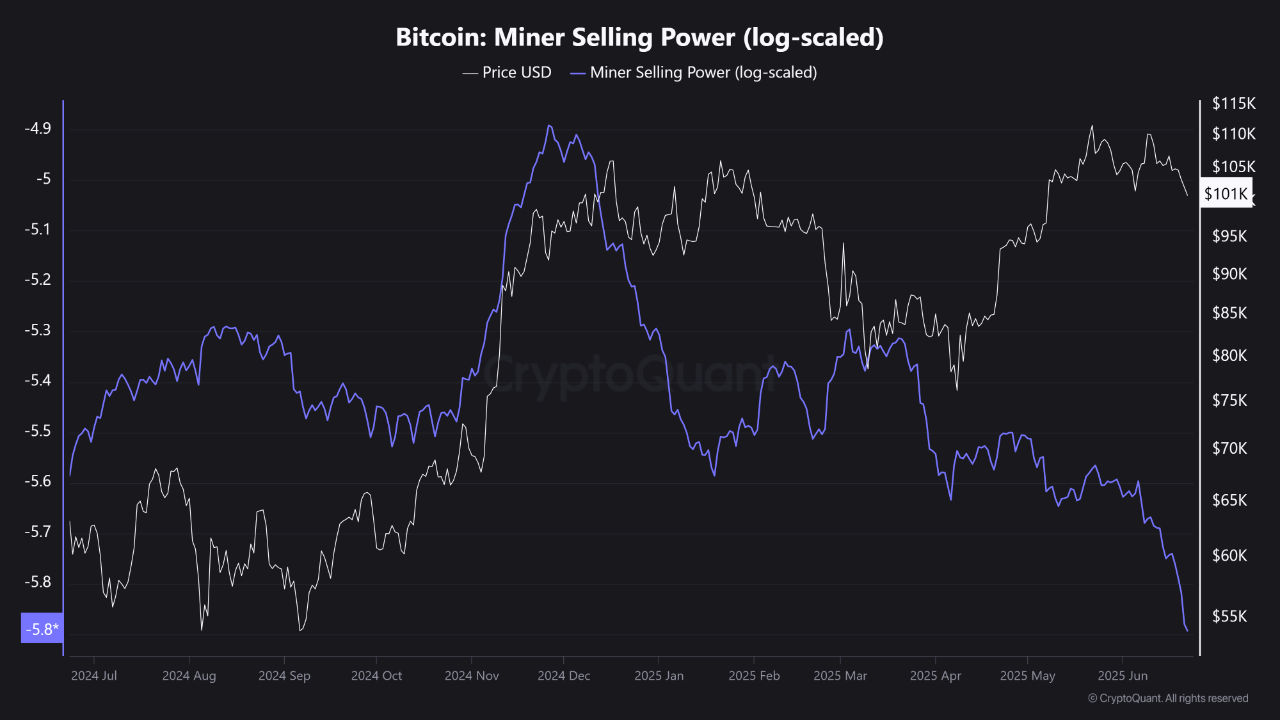
Data from CryptoQuant contributor IT Tech shows that Bitcoin miners are now “extremely underpaid.” Per the analyst, the market is in a phase of forced selloffs from mining operations to stay afloat.
In recent weeks, the sustainability metric has dropped deep into negative territory, with an uptick in selling power, meaning miners are leaning towards letting go of their holdings and away from mining.
Miners were fairly compensated during periods when Bitcoin traded in the $90,000–$105,000 range between March and May. Yet, since early June, the profitability is almost entirely eroded.
CryptoQuant’s Bitcoin: Miner Selling Power (log-scaled) chart reveals a downturn in the selling strength of miners. The metric, which accounts for how much Bitcoin miners are capable of offloading into the market, has hit a new low.
As of June 24, difficulty and hashrate values, a single miner operating at 390 TH/s and consuming 7,215 watts of power at $0.05/kWh would generate a mere $11.76 per day in profit. It would now take 5,156 days, more than 14 years, to mine a single Bitcoin under these conditions.
Mining power slides as geopolitical differences bite
On June 22, the United States launched targeted airstrikes against Iranian nuclear facilities. While not confirmed officially, it is believed that power stations may have been impacted.
Iran legalized Bitcoin mining in 2019 and built up a sizable network using subsidized electricity from fossil fuels and nuclear plants. At its peak, Iran accounted for approximately 4.5% of the global Bitcoin hashrate. The figure now stands closer to 3.1%.
Following the US strikes, there have been several reports of blackouts and digital network disruptions from both Iran and neighboring Israel. The outages could have affected mining facilities, either damaging or forcing them to shut down due to power loss.
Some analysts observed a sharp decline in Bitcoin’s hashrate earlier this week, with the network’s computational power dropping by 8% between Sunday and Thursday. The hashrate reportedly fell from 943.6 million terahashes per second (TH/s) to 865.1 million TH/s.
The market has so far rebounded against the backdrop of US President Donald Trump’s announcement of a “total ceasefire” agreement between Iran and Israel. Word from Trump seemingly helped restore investor confidence, pushing Bitcoin back up above the $106,000 level on Monday. At the time of this report, the largest coin by market cap is changing hands around $105,300.
Cryptopolitan Academy: Want to grow your money in 2025? Learn how to do it with DeFi in our upcoming webclass. Save Your Spot
